“All Their News,
Made Fit to Print”

Byadmin
Judge Faruqui files a 48-page opinion explaining his dismissal of the case against two ex-FBI officials, after Julie Kelly reported no written order had followed
Judge Faruqui filed a 48-page opinion Nov. 24 explaining his Nov. 2 bench dismissal of the Floris/Benavides complaint, after Julie Kelly reported Nov. 12 that no written order had followed.
Judge Faruqui files a 48-page opinion explaining his dismissal of the case against two ex-FBI officials, after Julie Kelly reported no written order had followed
Reporting: Julie Kelly (@julie_kelly2 · Declassified with Julie Kelly (declassified.live))
Created: 2026-11-16T22:57:00-05:00 (America/New_York)
Last updated: 2026-11-25T06:49:34-05:00 (America/New_York)
Living page — updated in place as new primary drops land.
The short version
On Nov. 2, Magistrate Judge Zia Faruqui dismissed from the bench the complaint charging former FBI officials Nikki Floris and Bradley Benavides with lying to Congress about the Hunter Biden laptop investigation. ABC, CBS, NBC and Politico covered the ruling.
On Nov. 12, Julie Kelly reported that no written order had followed. On Nov. 24, Faruqui filed a 48-page memorandum opinion that, in its words, “memorializes the basis” for the bench decision. The opinion says the government charged the two “at the behest of the President of the United States and the Director of the FBI.” We found no report yet on whether DOJ will seek review.
Update, Nov. 25: The written opinion Kelly flagged as missing is now on the docket. Magistrate Judge Zia M. Faruqui filed a 48-page Memorandum Opinion on Nov. 24, 2026, in United States v. Floris and Benavides, No. 26-mj-00185, docket entry 30 (CourtListener copy). It says the court “issued an oral decision” on Nov. 2 and that “this opinion memorializes the basis for that decision.” It opens by quoting then-Judge Kavanaugh on the risk of abuse in false-statement prosecutions and says the government, “unwilling or unable to obtain a grand jury indictment,” had to show probable cause at a preliminary hearing. Those are the court’s characterizations. We have not yet read whether the dismissal is with or without prejudice, and we found no DOJ response. Kelly’s reporting that no order had been filed was accurate when published.
On Nov. 2, 2026, U.S. Magistrate Judge Zia M. Faruqui of the District of Columbia dismissed a criminal complaint against Nikki Floris and Bradley Benavides, former senior FBI counterintelligence officials accused of making false statements to Congress about the bureau’s handling of the Hunter Biden laptop. He ruled from the bench after a preliminary hearing that ran across several days. “What has transpired here cannot be described as anything other than weaponization,” he said, as CBS News, ABC News, NBC News and Politico reported. The Justice Department said it “disagrees with the Magistrate’s decision” and is “evaluating all options” (CBS).
On Nov. 12, Julie Kelly reported a different angle on X: “Now, 10 days later, Faruqui still hasn’t issued an order officially dismissing the complaint–which prevents DOJ from filing an appeal.” She posted clips from the Nov. 2 hearing and noted that Chief Judge James Boasberg had held a status conference in the case on Oct. 29.
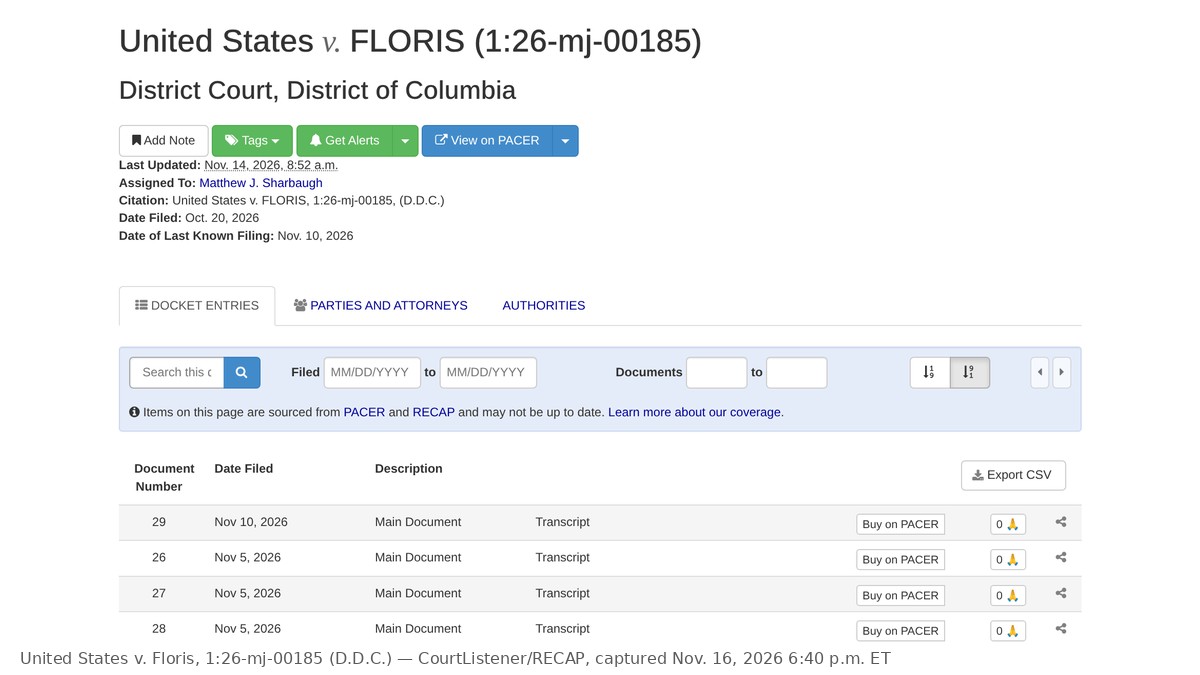
What the docket shows. We checked the CourtListener (RECAP) copy of the docket, United States v. Floris, No. 1:26-mj-00185 (D.D.C.), on Nov. 16 at about 8:26 a.m. and again at 6:40 p.m. ET. CourtListener last refreshed it from the court’s PACER system on Nov. 14 at 8:52 a.m. The Nov. 2 minute entry reads: “Preliminary Hearing as to NICOLE FLORIS (1), BRADLEY BENAVIDES (2) held on 11/2/2026. Case Dismissed. Order Forthcoming.” After it come a government notice of exhibits (Nov. 3, doc. 25) and four hearing transcripts (docs. 26–28 on Nov. 5; doc. 29 on Nov. 10). No dismissal order or opinion appears.
What cuts the other way. The CourtListener copy is only as current as its last pull from PACER, the court’s paid records system, on Nov. 14; an order filed after that would not show there, and we did not pull PACER directly. Kelly’s claim that the missing order “prevents DOJ from filing an appeal” is her legal reading: CBS reported on Nov. 2 that DOJ “could still appeal Faruqui’s ruling to the chief judge or seek a grand jury indictment,” and NBC said the case “theoretically could still move forward” before a grand jury. We make no finding on whether a written order is required first. We found no comment from the court or DOJ on the timing of the order.
Why it matters. The bench ruling got wide coverage on Nov. 2. The follow-up question, whether and when the judge puts the ruling in writing, which bears on what the government can do next, did not. We found no legacy story on the missing order as of Nov. 16.
Research quality: Public-docket reporting plus hearing video clips. Kelly’s core factual claim (no written order) checks out against the CourtListener docket copy (last refreshed Nov. 14). Her legal conclusion is attributed and unverified.
Attribution: Julie Kelly, X, Nov. 12, 2026; her newsletter is Declassified with Julie Kelly (declassified.live). “Weaponization” is the judge’s word; the legal reading on appeals is Kelly’s. The Media Now makes no finding on the merits of the case or on appeal procedure.
Chronology of drops
- 2026-10-20 — Complaint filed under seal (doc. 1); unsealed Oct. 23
- 2026-10-27 — Faruqui strikes the government’s proposed superseding complaint; protective order (doc. 21)
- 2026-10-29 — Status conference before Chief Judge Boasberg; preliminary hearing continues Oct. 28–Nov. 2
- 2026-11-02 — Bench ruling: “Case Dismissed. Order Forthcoming.” DOJ says it disagrees
- 2026-11-12 — Julie Kelly reports no written order after 10 days
- 2026-11-16 — Our docket check: still no order (CourtListener, last refreshed Nov. 14)
Sources
Pointers to originals. We do not close-paraphrase their prose — read the primaries.
- Primary: Julie Kelly on X, Nov. 12, 2026
- Julie Kelly’s newsletter, Declassified with Julie Kelly — Subscription newsletter; we did not read paywalled posts.
- Docket: United States v. Floris, No. 1:26-mj-00185 (D.D.C.), CourtListener/RECAP — Last refreshed from PACER Nov. 14, 2026, 8:52 a.m. ET.
- CBS News, Nov. 2, 2026
- NBC News, Nov. 2, 2026
- ABC News, Nov. 2, 2026
- Politico, Nov. 2, 2026
Open questions
- Has Faruqui filed a written order since CourtListener’s Nov. 14 refresh?
- Is a written order needed before DOJ can seek review by a district judge?
- Has DOJ sought review or a grand jury indictment?
Paywall / access notes
- Kelly’s newsletter is paid; we did not subscribe or read paywalled posts.