“All Their News,
Made Fit to Print”

Byadmin
USAID Files: After Murthy, agency lawyers told staff not to pressure platforms, and to “keep it out of the Washington Post”
A 2024 legal briefing, a staff FAQ and a blocked meeting readout show USAID’s lawyers policing platform contacts: no coercion, requests tied to platform rules, and caution about how the work would look.
USAID Files: After Murthy, agency lawyers told staff not to pressure platforms, and to “keep it out of the Washington Post”
Surfaced by: Edward Coristine (@as400495 · Records: USAID.gov)
Created: 2026-11-26T02:48:00-05:00 (America/New_York)
Last updated: 2026-11-27T06:50:09-05:00 (America/New_York)
The short version
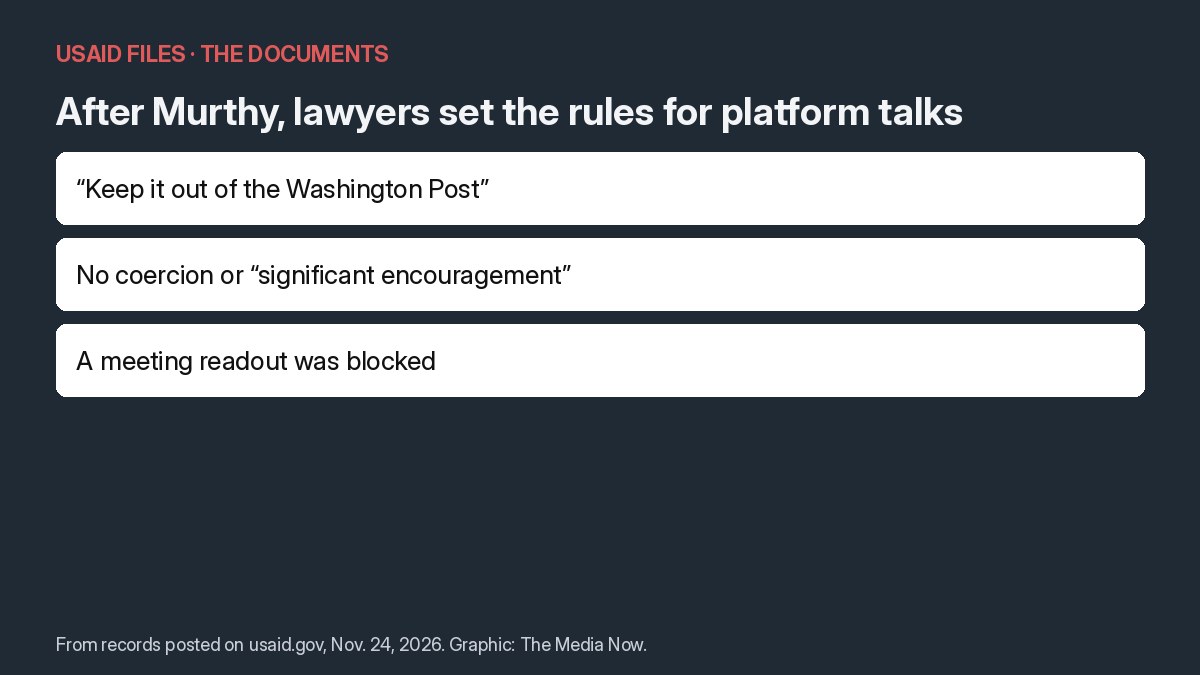
Several of the USAID Files are legal guidance written while courts weighed Missouri v. Biden. A July 2024 briefing by agency lawyer Chioma Ayogu tells staff to be “viewpoint neutral,” to write emails “as if you expect them to get FOIA’d,” and to “keep it out of the Washington Post.”
A September 2024 FAQ bars coercion or “significant encouragement” of platforms and limits requests to USAID staff, activities and the companies’ own rules. The same lawyers blocked a public readout of Samantha Power’s 2024 meeting with Meta. The files show restraint on paper and worry about appearances; they do not show a violation.
Ayogu’s talking points, dated July 8, 2024, after the Supreme Court’s June ruling in Murthy v. Missouri on standing grounds, say prior guidance “still applies as is for now,” urge staff to “keep it factual,” and list “Keep it out of the Washington Post” and “Write emails and gchats as if you expect them to get FOIA’d.” They add that “USAID doesn’t badger tech companies” (PDF). Read in full, the “Washington Post” line is about avoiding embarrassing language, not hiding activity; the same briefing tells staff the default is disclosure.
The internal FAQ, updated Sept. 27, 2024, says staff may raise content concerns with platforms only when they relate to USAID staff, activities or objectives and to a platform’s terms of service; bars “coercion” or “significant encouragement”; requires General Counsel clearance; and says senior leadership may not be enlisted to press companies (PDF).
In June 2024, when the press office proposed a readout of Power’s meeting with Meta’s president of global affairs, Ayogu wrote that the General Counsel “would have concerns about a readout due to Hill sensitivities and the ongoing Supreme Court litigation” (PDF). In April 2024, after Meta cut ties with Internews over a report on its Trusted Partner program, senior adviser Vera Zakem wrote she was “not comfortable in pressing on this further,” and Ayogu warned repeated questions “may be viewed as coercive” (PDF).
Critics read these records as proof the agency knew its work looked like coercion and managed the optics; defenders, including Power, read them as staff following the law. Both readings rest on the same documents. What the files do not contain is a finding by any court or inspector general that USAID crossed the line.
How we checked: Primary records opened from usaid.gov on Nov. 25–26, 2026; quotes checked against the PDFs. These are lawful internal guidance documents; this piece reports what they say and does not imply a violation the records do not show.
Release: the files were posted on usaid.gov by the Trump administration and announced on X by Edward Coristine (@as400495) at 8:56 p.m. ET Nov. 24. Coristine is lead engineer at the White House National Design Studio (NDS), formerly with DOGE; his X profile lists the official NDS site (ndstudio.gov). OMB Director Russ Vought, who has served as acting USAID administrator, wrote on X on Nov. 25 that the files went out “with more batches to come” (post). The selection of files is the administration’s. Former Administrator Samantha Power told Devex the files were a “baffling hodge-podge chosen by people who will do anything to avoid taking responsibility for their lethal mistakes” (Devex, as quoted in its post). Updated Nov. 27: Sen. Jeanne Shaheen, ranking member of the Senate Foreign Relations Committee, said in a statement posted by the committee Democrats’ account at 9:17 p.m. ET Nov. 25: “The Trump Administration’s posting of cherry-picked ‘USAID Files’ is a desperate attempt to cover up the damage of its closure—including the deaths of hundreds of thousands of people and the waste of billions of taxpayer dollars” (post).
Chronology of drops
- 2024-04-30 — Meta–Internews TPP follow-up: “may be viewed as coercive”
- 2024-06-14 — GC objects to a readout of Power’s Meta meeting
- 2024-06-26 — Supreme Court decides Murthy v. Missouri on standing
- 2024-07-08 — Ayogu briefing: injunction and content-moderation talking points
- 2024-09-27 — FAQ on communications with social media companies updated
Sources
Links go to the original documents.
- Injunction and content moderation talking points (July 8, 2024)
- FAQ on communications with social media companies (updated Sept. 27, 2024) — Marked for USAID internal use.
- RE: A/AID meeting readout, Meta president of global affairs (June 2024)
- RE: Follow-up on Meta TPP Internews report (Apr. 2024)
- Murthy v. Missouri, 603 U.S. (2024)
- Devex: Samantha Power’s statement
Open questions
- Did any USAID office make a request the FAQ would have barred, before or after it was written?
- Why did the democracy bureau want “no public amplification” of the Meta meeting, beyond the litigation?
- Has the agency’s inspector general reviewed USAID’s platform contacts?
Mainstream coverage note
Mainstream coverage: as of 2:30 a.m. ET Nov. 26 we found no story on the USAID Files from The New York Times, The Washington Post, AP, Reuters, CNN, NBC, ABC, CBS or NPR; Newsweek and the New York Post did cover the release. Our count: the coverage-gap report, Nov. 26.
More on USAID Files
- Nov. 26: The coverage gap at major outlets
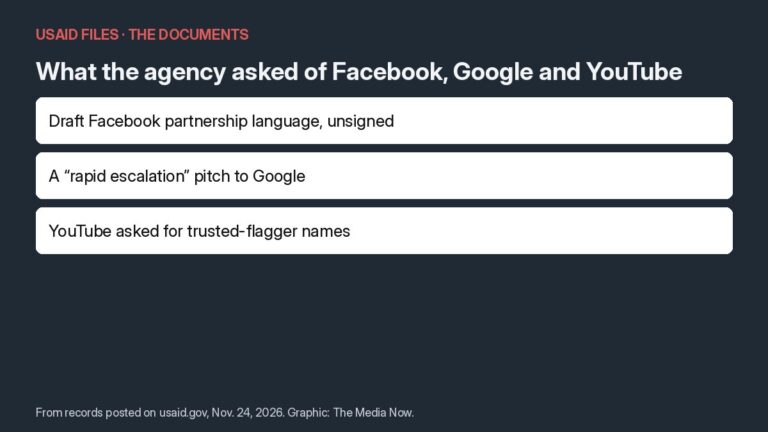
- Nov. 26: What the agency asked of Facebook, Google and YouTube
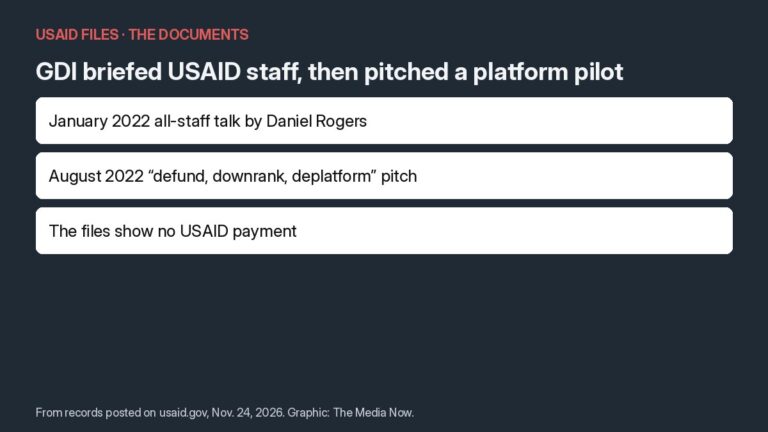
- Nov. 26: GDI’s briefing and its “defund, downrank, deplatform” pitch
- Nov. 26: The lawyers’ rules after Murthy (this article)

[…] Nov. 26: The lawyers’ rules after Murthy […]
[…] Nov. 26: The lawyers’ rules after Murthy […]
[…] Nov. 26: The lawyers’ rules after Murthy […]