“All Their News,
Made Fit to Print”

Byadmin
USAID Files: What the agency asked of Facebook, Google and YouTube, and what the companies said back
A draft Facebook partnership offering “countries of concern” lists, a “rapid escalation process” pitched to Google, and a trusted-flagger conversation with YouTube. The files show the asks; they do not show the companies agreed.
USAID Files: What the agency asked of Facebook, Google and YouTube, and what the companies said back
Surfaced by: Dan Frieth, Reclaim The Net (reclaimthenet.org)
Created: 2026-11-26T02:50:00-05:00 (America/New_York)
Last updated: 2026-11-27T13:05:45-05:00 (America/New_York)
The short version
Records posted on usaid.gov show USAID staff drafting undated partnership language for Facebook that included sharing “an annually updated list of countries of concern,” pitching Google and YouTube a “rapid escalation process for content moderation concerns,” and relaying YouTube’s invitation to send a list of recommended trusted flaggers.
The companies’ replies were cautious. Google said it would act only under “our existing policies and procedures.” An Internews official declined to share partners’ contacts. We found no record that Facebook adopted the draft. Reclaim The Net’s Dan Frieth first laid out several of these documents; we checked each against the originals.
The draft Facebook language is undated and unsigned. It proposes CrowdTangle access and ad credits for local partners, referrals into Facebook’s fact-checking and Trusted Partner programs, “sharing an annually updated list of countries of concern,” and an election-team contact to “flag potential spoilers or destabilizers to the political transition” (PDF). Nothing in the files shows Facebook signed or used it.
A 2022 talking-points memo for Google and YouTube lists, as the first ask, “Discussing MDM and a Rapid Escalation Process for Content Moderation Concerns,” and records Google saying that “if anyone sees something, Google wants to know and take action if it” violates policy (PDF). In written answers dated May 11, 2022, Google said it “will only assess and/or take action on concerns they raise based on our existing policies and procedures” (PDF).
In August 2022, USAID’s Joshua Machleder told Internews that YouTube said “if there are local groups that would be recommended to serve as ‘Trusted Flaggers’ … we should send over a list.” Internews’ Rafiq Copeland declined to share partners’ contacts, said Internews had “social media monitors already operating in about 20 countries,” and added: “I am pretty sure USAID is currently funding a lot of staff around the world to flag issues to the platforms through these trusted programs” (PDF). That is his belief, not an accounting; the files contain no list of funded flaggers.
The files also include specific removal requests, and they are narrower than the “censorship” framing suggests: in July 2022, USAID and NDI asked Facebook to remove posts threatening an NDI partner in Libya, and Facebook removed pages; in August 2022, USAID’s Sudan team flagged a post naming 38 Chemonics staff as “CIA operatives” (Libya PDF; Sudan PDF). Both concern the physical safety of named people.
Separately, a December 2022 White House National Security Council email forwarded to Power shows NSC staff sending YouTube, “following your suggestion,” a list of Russian independent outlets hurt by its ad cutoff, and YouTube saying new Google funding through the European Journalism Centre would cover “all the outlets that we’ve raised,” with grant decisions resting with the centre (PDF). A Kremlin envoy described this as the NSC instructing Google; the email does not show an instruction.
How we checked: Primary records opened from usaid.gov on Nov. 25–27, 2026; scanned Libya and Sudan PDFs were OCR-checked. Quotes checked against the originals. Not reviewed: most of the rest of the 248 files and the three videos.
Credit: Reclaim The Net published a series on these documents on Nov. 25, including pieces by Dan Frieth (the draft Facebook deal) and Rick Findlay (the trusted flaggers); their document citations checked out. Reclaim The Net is a free-speech advocacy outlet that has long criticized platform moderation. Release: the files were posted on usaid.gov by the Trump administration and announced on X by Edward Coristine (@as400495) at 8:56 p.m. ET Nov. 24. Coristine is lead engineer at the White House National Design Studio (NDS), formerly with DOGE; his X profile lists the official NDS site (ndstudio.gov). OMB Director Russ Vought, who has served as acting USAID administrator, wrote on X on Nov. 25 that the files went out “with more batches to come” (post). The selection of files is the administration’s. Former Administrator Samantha Power told Devex the files were a “baffling hodge-podge chosen by people who will do anything to avoid taking responsibility for their lethal mistakes” (Devex, as quoted in its post). Updated Nov. 27: Sen. Jeanne Shaheen, ranking member of the Senate Foreign Relations Committee, said in a statement posted by the committee Democrats’ account at 9:17 p.m. ET Nov. 25: “The Trump Administration’s posting of cherry-picked ‘USAID Files’ is a desperate attempt to cover up the damage of its closure—including the deaths of hundreds of thousands of people and the waste of billions of taxpayer dollars” (post).
Update, Nov. 27: a 2023 call with YouTube on Burma and Bangladesh
Notes dated April 20, 2023, from a call between YouTube and staff of USAID, the State Department and the National Security Council describe a pilot on “violence and atrocity prevention” starting with Burma, then Bangladesh (PDF). Parts of the notes are marked “(SBU)”; they are unsigned. They record the White House saying that State and USAID would “take the lead” so that the government’s “RFIs/asks do not fall through the cracks,” and YouTube describing its Trusted Flaggers program, a threat-escalation channel and its Threat Analysis Group as active in Burma, and its Trusted Flaggers program as active in Bangladesh.
Two lines bear on the question this article asks. One says it is “useful for YouTube to have concrete examples (e.g. channels / content) of what State / USAID finds most problematic, especially from the Field.” The next gives YouTube’s practice with another agency’s examples: YouTube “will get examples of VE content from NCTC and will respond to it – need to be careful this is not construed as USG-requested content removal.” The notes also record YouTube saying its content standards “apply equally to all speakers, in all languages, at all times.” The notes name no channel or video, and say nothing about what, if anything, YouTube removed.
Chronology of drops
- 2022-05-11 — Google’s written answers: action only under its own policies
- 2022-07 — Libya: USAID/NDI request removal of threatening posts; Facebook removes pages
- 2022-08-16 — Sudan: post naming 38 Chemonics staff flagged
- 2022-08-17 — Internews on YouTube Trusted Flaggers
- 2022-12-22 — NSC–YouTube Russia follow-up forwarded to Power
- 2023-04-20 — Notes from a State/USAID/NSC call with YouTube on Burma and Bangladesh
- 2026-11-24 — Files posted on usaid.gov
Sources
Links go to the original documents.
- Draft partnership language for Facebook (undated) — No author, no date; no sign of adoption.
- Talking points and asks for Google and YouTube (2022)
- USAID follow-up questions for Google (May 11, 2022)
- RE: YouTube Trusted Flagger Program (Aug. 2022)
- Fwd: YouTube / NSC Sync on Russia (Dec. 2022)
- Notes from USG Meeting with YouTube on Violence and Atrocity Prevention (Apr. 20, 2023) — Added Nov. 27.
- Reclaim The Net, “USAID Files: The Trusted Flaggers Nobody Can Audit” — Credited analysis; checked against the PDFs.
- Reclaim The Net, “USAID Files: A Draft Facebook Deal to Flag Election ‘Spoilers’”
Open questions
- Did Facebook ever accept any part of the draft partnership language?
- Which USAID awards, if any, paid for staff who flagged content to platforms, and in which countries?
- Did USAID send YouTube a list of recommended trusted flaggers?
- What do Meta, Google and YouTube say about these requests? None has commented in the coverage we found.
Mainstream coverage note
Mainstream coverage: as of 2:30 a.m. ET Nov. 26 we found no story on the USAID Files from The New York Times, The Washington Post, AP, Reuters, CNN, NBC, ABC, CBS or NPR; Newsweek and the New York Post did cover the release. Our count: the coverage-gap report, Nov. 26.
More on USAID Files
- Nov. 26: The coverage gap at major outlets
- Nov. 26: What the agency asked of Facebook, Google and YouTube (this article)
- Nov. 26: GDI’s briefing and its “defund, downrank, deplatform” pitch
- Nov. 26: The lawyers’ rules after Murthy

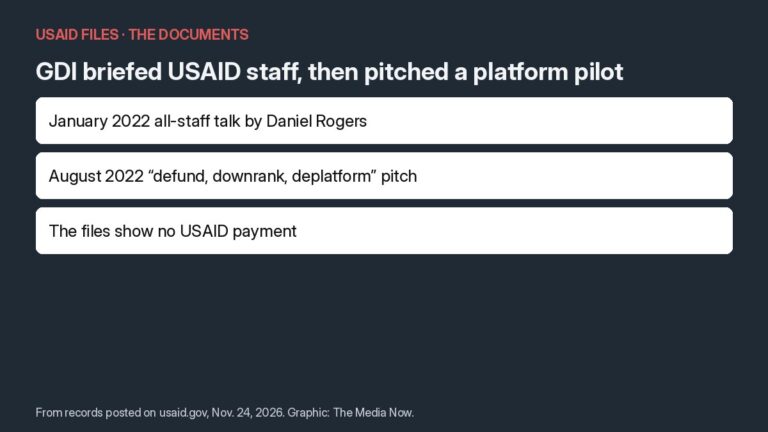
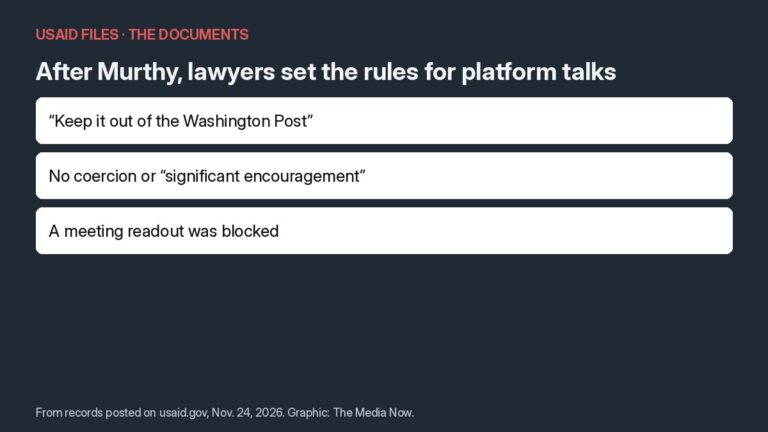
[…] Nov. 26: What the agency asked of Facebook, Google and YouTube […]
[…] Nov. 26: What the agency asked of Facebook, Google and YouTube […]
[…] Nov. 26: What the agency asked of Facebook, Google and YouTube […]