“All Their News,
Made Fit to Print”

Byadmin
USAID Files: The disinformation group that rated news sites briefed USAID staff with Breitbart examples, then pitched a “defund, downrank, deplatform” pilot
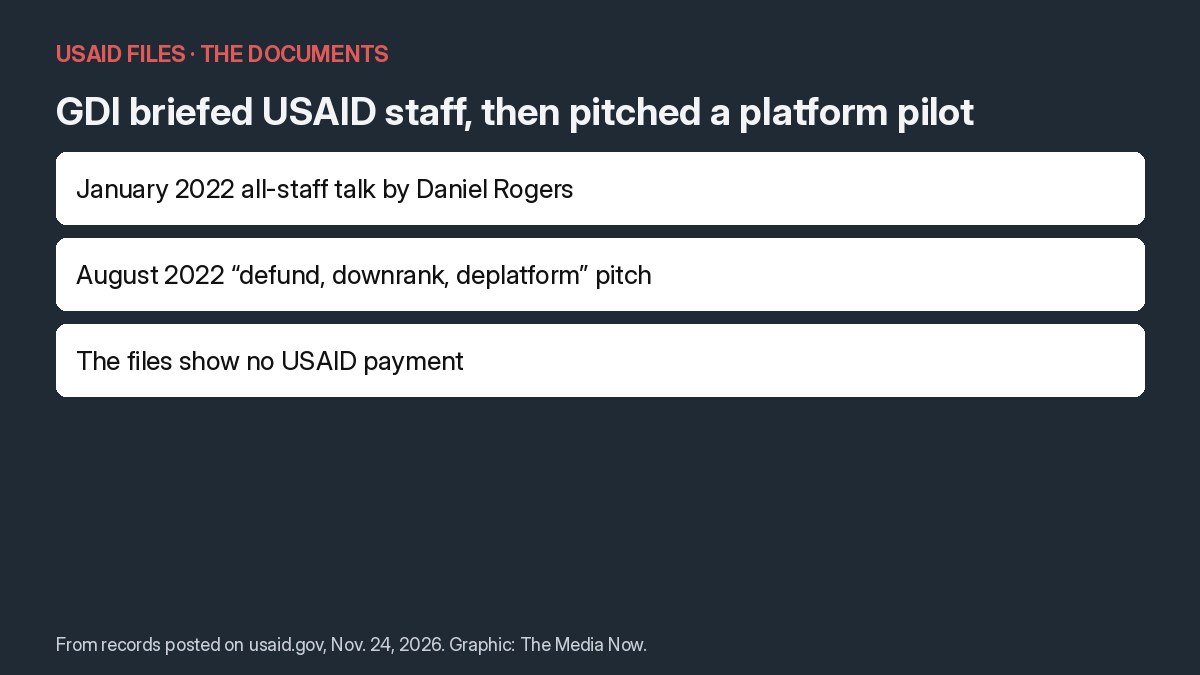
In January 2022, Global Disinformation Index co-founder Daniel Rogers gave an agency-wide USAID talk using Breitbart immigration-crime stories as examples of “adversarial narratives.” Months later GDI pitched a pilot. The files show no USAID payment.
USAID Files: The disinformation group that rated news sites briefed USAID staff with Breitbart examples, then pitched a “defund, downrank, deplatform” pilot
Surfaced by: Mike Benz (@MikeBenzCyber)
Created: 2026-11-26T02:49:00-05:00 (America/New_York)
Last updated: 2026-11-27T06:50:09-05:00 (America/New_York)
The short version
On Jan. 5, 2022, USAID invited all staff to a talk by Daniel Rogers, co-founder of the Global Disinformation Index, the group that rates news sites for “disinformation risk.” His slides, now on usaid.gov, define disinformation as “adversarial narratives” rather than falsehoods and show Breitbart stories on crimes by illegal immigrants as examples.
In July 2022 a senior USAID official sent GDI ten countries of interest; in August GDI proposed rating news media in Moldova, Zambia and Armenia and a pilot to “defund,” “downrank” and “deplatform” sites. The files show no USAID payment and no sign the pilot ran. Mike Benz first highlighted the lecture on X.
The invitation, sent by USAID’s Daniel Stolkowski on Jan. 5, 2022, describes “a discussion on mis- dis- and mal-information and its threat to democracy” co-sponsored by the Office of Security and the democracy center, “part of the quarterly SEC Guest Speaker Series which aims to help all USAID staff” (PDF).
Rogers’ 17-slide deck says GDI “views disinformation through the lens of adversarial narrative conflict,” including narratives that are “adversarial against an at-risk individual or group, or an institution like science, medicine, or democratically-elected government,” and that defining it “by adversarial narrative topic, such as anti-immigrant, misogyny, anti-vax” is “useful and compelling for brands.” One slide, titled “Adversarial Narratives,” shows a Breitbart page of “Crimes by Illegal Aliens” stories; another, “Examples of Pernicious Adversarial Narratives,” shows a Breitbart headline on Rudy Giuliani and the Pennsylvania tally. A results slide claims GDI and partners “redirected nearly $100M worth of ad revenue away from disinformation” (PDF). The slides do not say the Breitbart stories were false.
On July 14, 2022, Johnny Walsh, a deputy assistant administrator in the democracy bureau, followed up with Rogers and GDI co-founder Clare Melford with a list of ten countries and asked for a “one-pager” on collaboration (PDF). GDI’s August 2022 concept note proposed Media Market Reviews in Moldova, Zambia and Armenia “shared privately with USAID,” and a “USAID / Platform Intervention Pilot,” citing USAID’s “growing relationships with the large online platforms, including Alphabet and Meta,” to “Defund,” “Downrank” and “Deplatform” (PDF).
What the files do not show: any USAID award to GDI, or that the pilot happened. In September 2022 a team lead asked colleagues for Rogers’ email to “learn more” about GDI’s research (PDF), and in January 2023 a staffer wrote that GDI “came in and met with us a few months ago” (PDF). GDI did receive other U.S. money earlier, through the State Department’s Global Engagement Center and the National Endowment for Democracy, according to earlier reporting and congressional letters; the State Department has said its award ended in 2022.
How we checked: Primary records opened from usaid.gov on Nov. 25–26, 2026; Rogers’ image-only slides read by OCR at 110 dpi and spot-checked. The 64-minute video of the talk was not watched; quotes from it are not used here.
Credit and disclosure: Mike Benz (@MikeBenzCyber) runs the Foundation for Freedom Online and is a former State Department official; his X bio lists “The USAID Files,” and he posted that the site was live at 7:23 p.m. ET Nov. 24, before the official announcement, so he may have been involved in the release. His posts say GDI cost conservative outlets “$200 million” and was “recommended to USAID by the US intelligence community.” The files we read do not include an intelligence-community recommendation; a GDI slide in the files claims “nearly $100M” redirected (PDF). Release: the files were posted on usaid.gov by the Trump administration and announced on X by Edward Coristine (@as400495) at 8:56 p.m. ET Nov. 24. Coristine is lead engineer at the White House National Design Studio (NDS), formerly with DOGE; his X profile lists the official NDS site (ndstudio.gov). OMB Director Russ Vought, who has served as acting USAID administrator, wrote on X on Nov. 25 that the files went out “with more batches to come” (post). The selection of files is the administration’s. Former Administrator Samantha Power told Devex the files were a “baffling hodge-podge chosen by people who will do anything to avoid taking responsibility for their lethal mistakes” (Devex, as quoted in its post). Updated Nov. 27: Sen. Jeanne Shaheen, ranking member of the Senate Foreign Relations Committee, said in a statement posted by the committee Democrats’ account at 9:17 p.m. ET Nov. 25: “The Trump Administration’s posting of cherry-picked ‘USAID Files’ is a desperate attempt to cover up the damage of its closure—including the deaths of hundreds of thousands of people and the waste of billions of taxpayer dollars” (post).
Chronology of drops
- 2022-01-05 — Rogers’ agency-wide talk, “Information Disorder and Its Threat to Democracy”
- 2022-07-14 — Walsh sends GDI ten countries, asks for a one-pager
- 2022-08 — GDI concept note: MMRs and platform pilot
- 2022-09-13 — Team lead seeks Rogers’ contact
- 2023-01 — “Came in and met with us a few months ago”
Sources
Links go to the original documents.
- GDI / D. Rogers presentation to USAID (Jan. 2022), 17 slides — Image slides; text checked by OCR.
- Webinar invitation (Jan. 5, 2022)
- RE: Great talking to you / GDI (July 2022)
- GDI concept note for USAID (Aug. 2022)
- GDI call for country partners (MMRs)
- Mike Benz on X, Nov. 25, 2026 — Credited for surfacing the lecture.
- Rational Ground, transcript-based account of the lecture video — Includes its own “what we don’t know” section.
Open questions
- Did USAID, or any implementing partner using USAID money, pay GDI for ratings or the pilot?
- Were the Moldova, Zambia or Armenia reviews produced, and were they shared with platforms?
- What did USAID staff do with the January 2022 briefing? The files show interest, not action.
- What does GDI say about its use of Breitbart examples? It has not commented in the coverage we found.
Mainstream coverage note
Mainstream coverage: as of 2:30 a.m. ET Nov. 26 we found no story on the USAID Files from The New York Times, The Washington Post, AP, Reuters, CNN, NBC, ABC, CBS or NPR; Newsweek and the New York Post did cover the release. Our count: the coverage-gap report, Nov. 26.
More on USAID Files
- Nov. 26: The coverage gap at major outlets
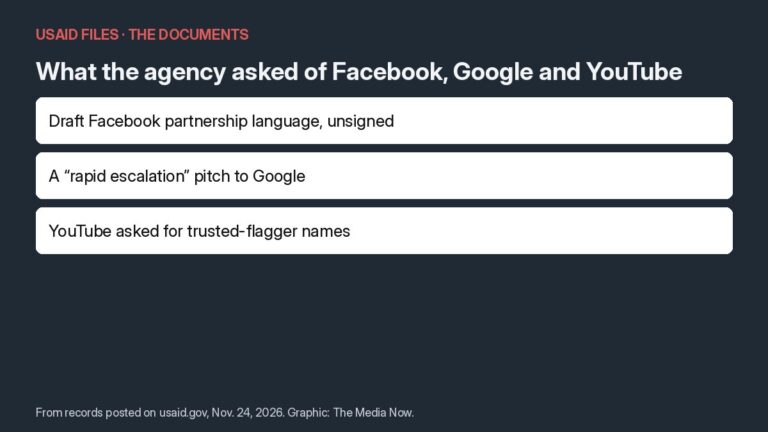
- Nov. 26: What the agency asked of Facebook, Google and YouTube
- Nov. 26: GDI’s briefing and its “defund, downrank, deplatform” pitch (this article)
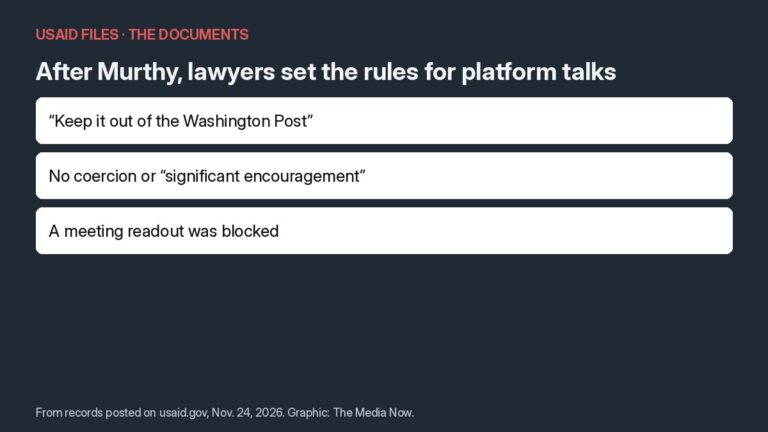
- Nov. 26: The lawyers’ rules after Murthy

[…] Nov. 26: GDI’s briefing and its “defund, downrank, deplatform” pitch […]
[…] Nov. 26: GDI’s briefing and its “defund, downrank, deplatform” pitch […]