“All Their News,
Made Fit to Print”

Byadmin
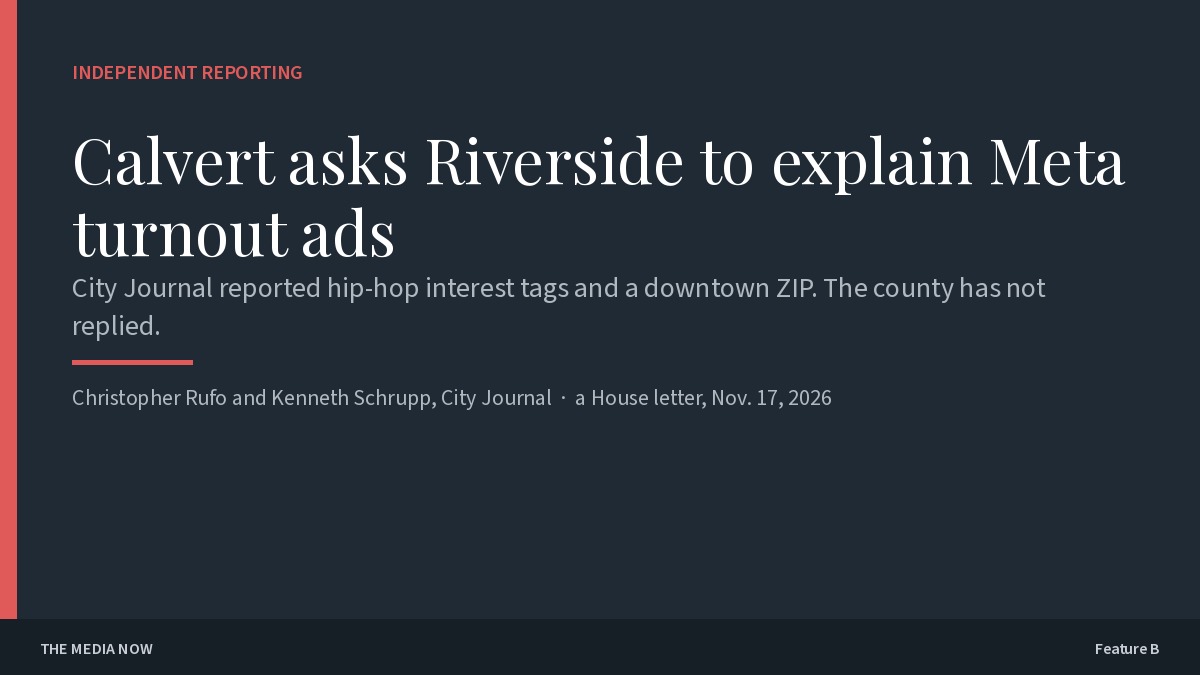
Rep. Calvert asks Riverside County to explain Meta turnout ads that City Journal says used “Gangsta rap” targeting
Christopher Rufo and Kenneth Schrupp reported that Riverside and San Diego registrar ads on Meta used cultural-interest and language tags they called proxies for Democratic-leaning voters. Calvert’s Nov. 17 letter, which credits that reporting, asks who approved the ads and why. A 2023 settlement required Riverside to do low-turnout outreach in English and Spanish; federal and state law also require language assistance. “The bias was blatant” is the authors’ inference. The county registrar says the campaign was broad and nonpartisan.
Rep. Calvert asks Riverside County to explain Meta turnout ads that City Journal says used “Gangsta rap” targeting
Reporting: Christopher F. Rufo, Kenneth Schrupp — City Journal / Manhattan Institute (@christopherrufo · @kennethschrupp)
Created: 2026-11-23T07:00:00-05:00 (America/New_York)
Last updated: 2026-11-25T06:47:50-05:00 (America/New_York)
Living page — updated in place as new primary drops land.
The short version
Rep. Ken Calvert sent a Nov. 17 letter to Riverside County Board Chair Karen Spiegel asking the board to explain turnout ads the Registrar of Voters placed on Facebook and Instagram from Sept. 28 through Nov. 2. His Nov. 20 press release credits a Nov. 9 City Journal report by Christopher F. Rufo and Kenneth Schrupp and lists targeting tags his office says came from Meta’s public ad database, including “Gangsta rap,” “Wiz Khalifa” and “Rick Ross.”
Rufo and Schrupp, reviewing a week of ads ending Nov. 1, wrote that the two counties directed taxpayer-funded turnout ads at cultural-interest and language tags they described as proxies for Democratic-leaning voters. “The bias was blatant” is their inference, not a finding this page adopts. A 2023 settlement of a 2022 lawsuit requires Riverside to do low-turnout outreach in English and Spanish in districts with a contested supervisorial election, and federal and state law require language assistance. This page could not open Meta’s Ad Library without a login. The county registrar’s office now says the campaign was broad and nonpartisan.
Update, Nov. 25: The Riverside County registrar’s office has responded. Spokesperson Elizabeth Florer told The Press-Enterprise that ads aimed at the 92501 ZIP code were less than 1 percent of the get-out-the-vote budget, that music-interest tags were roughly 8 percent of the county’s Meta ad spending, and that most of that spending used standard age, language and geographic settings and was not designed to target voters by race, ethnicity or political affiliation, as relayed by Patch (Nov. 24). We have not seen The Press-Enterprise original or the county’s figures, and Meta’s Ad Library still could not be checked without a login.
On Nov. 17, 2026, Rep. Ken Calvert wrote to Karen Spiegel, chair of the Riverside County Board of Supervisors, about voter-outreach ads he said the county Registrar of Voters had placed on Meta platforms — Facebook and Instagram — from Sept. 28 through Nov. 2. The letter quotes the ads as telling voters, “don’t wait for Election Day to make your voice heard. Make your plan and vote early.” Calvert wrote that, according to Meta’s public ad transparency database, the office used detailed-targeting tags that included “Gangsta rap,” “Wiz Khalifa,” “Rick Ross,” “Kanye West” and “2 Chainz,” among others, and that the complete list of music tags “was solely limited to those associated with rap, hip-hop, and R&B music artists.” He also wrote that the same database “indicates that more than 10 percent of social media ads placed by the Riverside County ROV were geographically targeted to a single zip code, 92501, located in downtown Riverside.” The letter credits a Nov. 9 City Journal article by Christopher F. Rufo and Kenneth Schrupp. A Nov. 20 press release from Calvert’s office published a longer keyword list. “Americans expect those who conduct our elections to do so in a manner that is fair and without any political bias,” said Rep. Calvert. “The decision by the Riverside County Registrar of Voters office to spend tax dollars to encourage select populations of voters to cast a ballot in the November election is deeply troubling. Riverside County voters deserve to know why the Registrar of Voters wants fans of ‘gangsta rap’ to vote more than fans of other genres, like country music. Riverside County voters also deserve to know why the Registrar of Voters wants residents of a single downtown Riverside zip code to vote more than residents in other zip codes.” This page opened the letter PDF and the press release; it has not independently opened the underlying Meta records (see below).
In the City Journal article, Rufo and Schrupp said they reviewed a week of Riverside and San Diego social-media advertising ending Nov. 1, ahead of the Nov. 3 midterms. For Riverside, where they wrote that Donald Trump had defeated Kamala Harris by 1.3 percent in 2024, they reported that more than 10 percent of Meta advertising dollars went to a downtown Riverside ZIP code where they estimated Harris won 58 percent of the vote, that “detailed targeting” dollars went to users linked to tags such as “Wiz Khalifa,” “Soul music,” “Rick Ross,” “2 Chainz” and “Gangsta rap,” and that more than 40 percent of Meta ad spending in the week they reviewed was directed at Spanish-speaking audiences. For San Diego, they reported that nearly 65 percent of Meta ad spending went to viewers who spoke Filipino, Chinese and other non-English languages, and that ads also targeted users Meta linked to tags such as “African-American history,” “African-American studies,” “African culture” and “Native American studies.” They called those tags “proxies for groups that favor Democrats,” wrote that “the bias was blatant,” and concluded that the counties were “engaged in a microtargeted turnout operation.” Those characterizations are the authors’ inferences. This page does not adopt them as findings. City Journal wrote that Riverside and San Diego did not respond to its requests for comment.
There is a documented legal backdrop for some, but not all, of this outreach. On June 14, 2022, Inland Empire United and six residents, represented in part by the ACLU Foundation of Southern California, filed Inland Empire United, et al. v. County of Riverside, et al., Riverside Superior Court Case No. CVRI2202423, alleging that a 2021 supervisorial map diminished Latino voters’ ability to participate fully in the political process. The parties settled; the agreement’s effective date is Sept. 12, 2023. For contested Board of Supervisors elections through 2030, the county agreed to fund pre-election outreach in English and Spanish at a minimum of $1.75 per registered voter in cities, census-designated places and unincorporated census areas whose turnout in a specified prior election was below the countywide rate. The settlement expressly lists “geotargeted social media placements” as a form of media that may count toward that spending, and it says the Registrar “will determine which form of media is best suited to reach the targeted voters.” It also allows, “where feasible,” targeting within those localities to precincts with lower-than-countywide turnout. It does not mention music-interest tags, hip-hop, or “Gangsta rap.” In a settlement announcement, ACLU SoCal staff attorney Julia Gomez said the agreement “opens more doors for our Latine community members in Riverside to participate in the future health and success of their home regions.”
A county “Updated 2024 Voter Outreach and Education Plan” prepared under that settlement lists the City of Riverside, in Supervisorial District 1, among localities the Registrar would focus on for the November 2024 general election. Using the November 2022 general, the plan records city turnout of 42.26 percent (67,952 votes of 160,790 registered), below the countywide 46.13 percent figure the plan uses as its cutoff. ZIP code 92501 sits inside that city; targeting a single ZIP is a narrower choice than the citywide list. This page has not independently opened a 2026 outreach plan, so it does not treat the 2024 list as proof of the 2026 targeting rationale. The settlement’s funding mandate applies only in supervisorial districts with a contested election. A Sept. 8, 2026 Press-Enterprise preview of the Nov. 3 Riverside County ballot listed congressional, state legislative, city council and school-board races and did not list a Board of Supervisors contest. This page has not opened the official sample ballot, so that is not a definitive finding.
Federal and state language-assistance rules, which the City Journal article did not discuss, are also part of the context. Section 203 of the Voting Rights Act requires covered counties to provide election materials and assistance in designated minority languages. The California Secretary of State’s current chart, based on the Dec. 8, 2021 Section 203 determinations and on Elections Code § 14201, lists Riverside as covered under Section 203 for Hispanic/Spanish and, under § 14201, for Chinese, Hmong, Japanese, Korean, Punjabi, Spanish, Tagalog, Thai, Urdu and Vietnamese. San Diego is listed under Section 203 for Chinese (including Taiwanese), Hispanic, Filipino and Vietnamese, plus a longer § 14201 list. Those mandates can explain why a registrar would buy ads in Spanish, Chinese or Filipino; they do not, by themselves, require interest tags such as “Gangsta rap.” Calvert contrasted the music tags with the Registrar’s published mission, which this page confirmed in the county’s Nov. 3, 2026 Election Guide: “Ensure the electoral process will be conducted professionally, consistently demonstrating neutrality and non-partisan decision-making … on behalf of those we serve.” His letter asks who had final authority to approve the ads, how the tags were chosen and why other genres such as country music were not used, why about 10 percent of the Meta ads went solely to users in 92501, whether ads ran on other platforms, and whether an outside vendor placed them and at what cost.
This page attempted to check those claims in Meta’s public Ad Library. Requests to facebook.com/ads/library and to the unauthenticated Graph ads_archive endpoint from this environment returned HTTP 403 or empty responses; the documented API requires an access token. As a result, spend ranges, impression counts, the precise share of ads or dollars sent to 92501, the language-spend percentages, San Diego’s advertiser page, and whether music tags were the only detailed-targeting interests could not be independently verified here. One inconsistency is already visible in the congressional record: “2 Chainz” appears in the City Journal article and in Calvert’s Nov. 17 letter, but it does not appear on the “complete list” of keywords in the Nov. 20 press release. City Journal reviewed the week ending Nov. 1; Calvert describes ads running Sept. 28 through Nov. 2, so their percentage figures are not necessarily drawn from the same window. No public response from Registrar Art Tinoco, Chair Spiegel, or the Board of Supervisors was located in Calvert’s release or in Nov. 20–21 write-ups by the Washington Examiner, the Temecula Sun and SoCal Daily Pulse; county websites returned Cloudflare challenges and could not be read. The registrar’s office has since responded: spokesperson Elizabeth Florer told The Press-Enterprise the figures and nonpartisan-design description in the Nov. 25 update, as relayed by Patch (Nov. 24). No public response from Chair Spiegel or the Board was identified in that report. Disclosure: City Journal is published by the Manhattan Institute, a free-market think tank. Rufo is a Manhattan Institute senior fellow and City Journal contributing editor who also describes himself as an activist; Schrupp is a City Journal investigative reporter. Both are already in The Media Now’s Feature B pool. Calvert is a Republican whose district includes part of Riverside County.
Research quality: Primary records opened for this page are Calvert’s Nov. 17, 2026 letter to Chair Spiegel (PDF on calvert.house.gov, two scanned pages, read in full), the Nov. 20 House press release, the Nov. 9 City Journal article by Rufo and Schrupp, the fully executed Sept. 12, 2023 settlement in Inland Empire United v. County of Riverside (Case No. CVRI2202423), the ACLU SoCal settlement announcement, the county’s Updated 2024 Voter Outreach and Education Plan (City of Riverside turnout table and language-assistance discussion), the Nov. 3, 2026 Riverside County Election Guide mission statement, and the California Secretary of State’s language-requirements chart (Section 203 and Elections Code § 14201). Meta’s Ad Library web pages and the unauthenticated ads_archive API were not reachable (HTTP 403 / empty); no spend, impression, or targeting breakdown was independently verified from Meta. County HTML sites were blocked by a Cloudflare challenge. A 2026 settlement outreach plan and the official Nov. 3 sample ballot were not opened.
Attribution: Christopher F. Rufo and Kenneth Schrupp, City Journal, Nov. 9, 2026; Rep. Ken Calvert letter to Chair Karen Spiegel, Nov. 17, 2026, and House press release, Nov. 20, 2026; settlement agreement in Inland Empire United v. County of Riverside, effective Sept. 12, 2023; California Secretary of State language-requirements chart. “The bias was blatant,” “proxies for groups that favor Democrats,” and the claim of a partisan microtargeted turnout operation are the authors’ inferences, not this page’s. Disclosure: City Journal is published by the Manhattan Institute; Rufo also describes himself as an activist. Calvert is a Republican whose district includes part of Riverside County. Rufo and Schrupp are already in the Feature B pool (Strong).
Chronology of drops
- 2022-06-14 — Inland Empire United and six residents file Inland Empire United, et al. v. County of Riverside, et al., Riverside Superior Court Case No. CVRI2202423, alleging that a 2021 supervisorial map diminished Latino voters’ ability to participate fully in the political process. Date is from the settlement’s recitals.
- 2023-09-12 — Settlement agreement takes effect — English-and-Spanish low-turnout outreach at $1.75 per registered voter in contested supervisorial elections through 2030; geo-targeted social media is an allowed media category.
- 2023-09 — ACLU of Southern California announces the settlement — Includes Julia Gomez’s “opens more doors for our Latine community members” quote.
- 2024 — County Updated 2024 Voter Outreach and Education Plan — Lists the City of Riverside (42.26% turnout in the November 2022 general, below the plan’s 46.13% countywide cutoff) among District 1 localities targeted for the November 2024 general. This is a 2024 plan, not a 2026 plan.
- 2026-09-08 — Press-Enterprise ballot preview for Nov. 3 — Lists congressional, state, city-council and school-board races; does not list a Board of Supervisors contest. Official sample ballot not opened.
- 2026-09-28 to 2026-11-02 — Dates Calvert’s letter gives for the Riverside Registrar’s Meta ads (Facebook and Instagram). City Journal reviewed the week ending Nov. 1, a shorter window.
- 2026-11-09 — City Journal: “California Counties Targeted Get-Out-the-Vote Ads to Users Interested in ‘Gangsta Rap’” — Bylines Christopher F. Rufo and Kenneth Schrupp. Counties did not respond to the authors’ requests for comment, the article says.
- 2026-11-17 — Rep. Ken Calvert letter to Board Chair Karen Spiegel — Credits City Journal; asks five oversight questions; cites Meta’s public ad database for tags and the 92501 geographic share.
- 2026-11-20 — Calvert office press release — Publishes a longer keyword list and quotes Calvert on “gangsta rap” and the downtown ZIP. “2 Chainz,” named in the letter and in City Journal, is not on that “complete list.”
Sources
Pointers to originals. We do not close-paraphrase their prose — read the primaries.
- Primary reporting: Christopher F. Rufo and Kenneth Schrupp, “California Counties Targeted Get-Out-the-Vote Ads to Users Interested in ‘Gangsta Rap,’” City Journal, Nov. 9, 2026
- Primary: Rep. Ken Calvert letter to Chair Karen Spiegel, Nov. 17, 2026 (PDF)
- Rep. Calvert press release, Nov. 20, 2026
- Settlement agreement, Inland Empire United v. County of Riverside, effective Sept. 12, 2023
- ACLU of Southern California settlement announcement
- County of Riverside Registrar of Voters, Updated 2024 Voter Outreach and Education Plan
- County of Riverside, Election Guide, Nov. 3, 2026 — Mission statement, confirmed verbatim.
- California Secretary of State, Language Requirements for Election Materials — Section 203 and Elections Code § 14201 chart, effective Jan. 1, 2026, for the June 2, 2026 election and thereafter.
- U.S. Census Bureau / Federal Register, Section 203 determinations, Dec. 8, 2021
- Press-Enterprise, “Who’s on the Nov. 3 ballot in Riverside County?,” Sept. 8, 2026 — Used only for whether a supervisor race appeared in that preview.
- Meta Ad Library (attempted, not opened): public search URL for Riverside County Registrar of Voters; API documentation at facebook.com/ads/library/api.
Open questions
- Can a signed-in or browser session open Meta’s Ad Library and verify spend ranges, impression counts, the 10 percent / 92501 figure, the language-spend percentages, San Diego’s ads, and whether music tags were the only detailed-targeting interests? This page could not.
- The registrar’s office has responded: spokesperson Elizabeth Florer told The Press-Enterprise, as relayed by Patch (Nov. 24), the figures in the Nov. 25 update. Has Chair Spiegel or the Board of Supervisors issued a public response? None was identified in that report. County websites were not readable here (Cloudflare challenge).
- Was there a contested 2026 Board of Supervisors election that triggered the settlement’s $1.75 spending mandate? A Press-Enterprise ballot preview did not list one; the official sample ballot was not opened.
- Is there a published 2026 outreach plan listing target localities? Only the 2024 plan was opened.
- Why does “2 Chainz” appear in City Journal and in Calvert’s Nov. 17 letter but not on the Nov. 20 press release’s “complete list” of keywords?
Mainstream coverage note
A morning Google News check used for the Nov. 23 Feature A edition found the City Journal article itself as the main hit on the underlying Ad Library reporting. After Calvert’s Nov. 17 letter and Nov. 20 release, the Washington Examiner, the Temecula Sun and SoCal Daily Pulse published follow-ups. This page has not independently canvassed every national desk. The distinctive work here is reading the letter, the settlement and the language-assistance rules, and stating plainly what could not be verified in the Ad Library.