“All Their News,
Made Fit to Print”

Byadmin
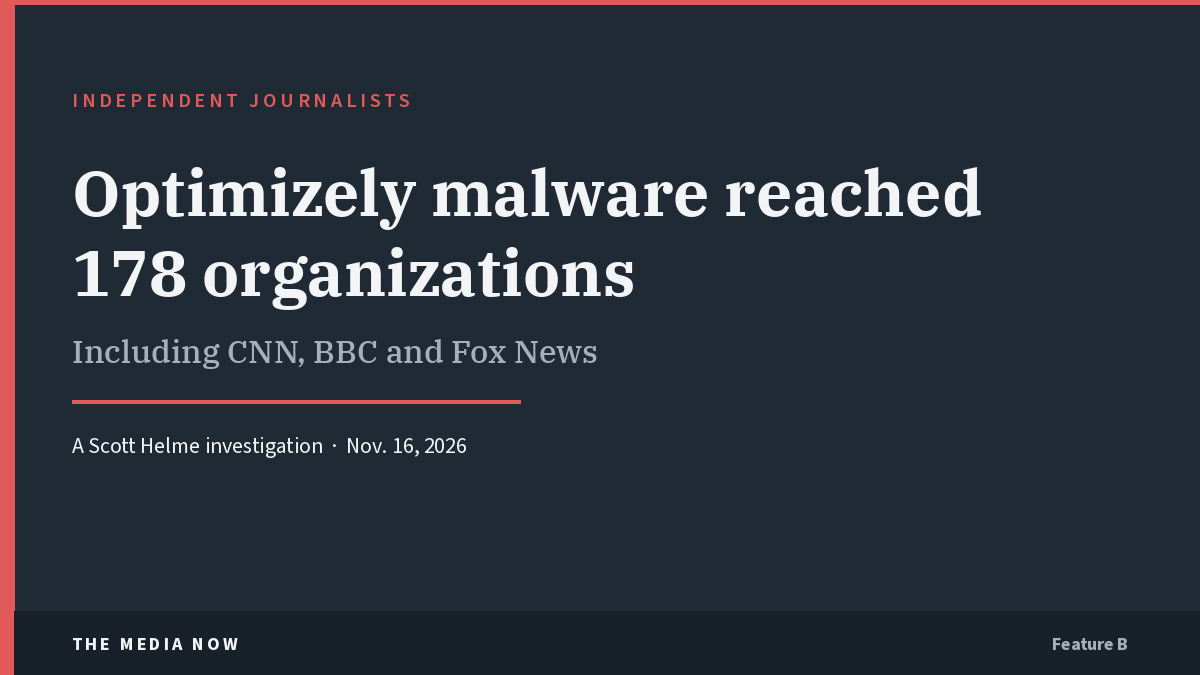
Helme: Optimizely malware reached 178 organizations, including CNN, BBC and Fox — and those news sites have not told their readers
Scott Helme published the original technical investigation on Nov. 16. BleepingComputer independently confirmed it. Optimizely confirmed the incident to Gizmodo. A Reuters-bylined wire circulated the same day. A Nov. 17 morning check found no CNN, BBC or Fox News story for their own readers. Helme founded Report URI, which sells this kind of monitoring.
Helme: Optimizely malware reached 178 organizations, including CNN, BBC and Fox — and those news sites have not told their readers
Reporting: Scott Helme (@Scott_Helme · blog.report-uri.com)
Created: 2026-11-17T06:51:00-05:00 (America/New_York)
Last updated: 2026-11-17T06:51:00-05:00 (America/New_York)
Living page — updated in place as new primary drops land.
The short version
Scott Helme reported Nov. 16 that malware served through Optimizely reached visitors of 178 organizations, including CNN, BBC and Fox News. BleepingComputer independently confirmed the infected scripts. Optimizely told Gizmodo it had fixed a signup-flow flaw and removed the code.
A Reuters-bylined wire circulated the same day, but a Nov. 17 morning check found no CNN, BBC or Fox News story for their own readers. Helme published the technical evidence; he also founded Report URI, which sells this kind of monitoring — a conflict this page discloses.
On Nov. 16, 2026, UK security researcher Scott Helme reported that malicious JavaScript had been served to visitors of 178 organizations through Optimizely’s Web experimentation platform. His list included some of the most visited sites in the world: Zoom, the BBC, CNN, Salesforce, GitLab, IKEA, HSBC, Equifax, Air France-KLM, Ledger and Peacock, and also Fox News. Helme wrote that he found 188 infected snippets in a set of 1,611 Optimizely files he checked. The attacker had written code into the Project JavaScript field of customer projects; the rest of each snippet was untouched, and the file was still served from Optimizely’s own network.
Helme’s blog describes a payload that tried to swap cryptocurrency addresses for the attacker’s wallets, skim card numbers from forms, steal cookies and screenshots, and load the Coruna and DarkSword exploit kits on iOS devices. He published indicators of compromise and a list of affected organizations. As of 19:25 UTC on Nov. 16, he wrote, the attacker’s wallets had received about $7,040 — a figure he presented as an early count, not a full accounting. By 21:52 UTC that evening, he found the malicious code still present in only one of the 188 infected snippets (TalkTalk); the rest had been cleaned.
BleepingComputer independently confirmed that the malicious script loaded, or tried to load, on numerous affected sites, using urlscan.io records and its own analysis of the modified JavaScript, including CNN, the BBC, Zoom and Salesforce. Optimizely went on the record to Gizmodo: spokesperson Victoria Johnson said an unauthorized party exploited a vulnerability in the Experimentation account-signup flow, added malicious JavaScript to some customer projects, and that Optimizely had blocked the path, deployed a fix, removed the injected code and notified affected customers. Gizmodo also noted that Report URI sells malicious-script detectors.
A Reuters-bylined wire dated Nov. 16, published under the headline “Popular websites subverted in bid to steal crypto, target iPhone users,” named Zoom, HSBC, Equifax, CNN, Salesforce and IKEA, quoted Helme, and said Reuters could not immediately tell whether the code was successfully used in each case. This page opened the wire as republished by Investing.com (“By Reuters”) and Channel News Asia (the same text, including that Optimizely, Apple, Zoom, HSBC, CNN and IKEA had not immediately responded to Reuters). The original reuters.com URL was not independently opened. Salesforce told Reuters it had disabled unauthorized Optimizely script changes; Equifax said it had stopped using Optimizely and found no evidence its systems were compromised.
The remaining gap is the newsrooms that were on the list. A check on the morning of Nov. 17, 2026, did not find a CNN, BBC or Fox News story telling their own readers that their sites had served the malware. That is the reason this page exists, and it is not a claim that no one covered the incident: tech-security outlets and Gizmodo did, and a Reuters wire was syndicated. Disclosure: Helme is the founder of Report URI, a company that sells client-side script monitoring of the kind that flagged this campaign. He is not on The Media Now’s reporter pool; this draft is staged for Steve’s approval and is not a nomination to the pool or to any list.
Research quality: Original technical investigation by Helme (infected-snippet counts, a list of organizations, indicators of compromise, and a payload breakdown). Independently confirmed by BleepingComputer (urlscan.io records and JavaScript analysis). Optimizely is on the record to Gizmodo. A Reuters-bylined wire was opened in syndication (Investing.com and Channel News Asia), not on reuters.com. This page re-checked CNN, BBC and Fox News on the morning of Nov. 17 and did not find a reader-facing story.
Attribution: Scott Helme / Report URI, Nov. 16, 2026; BleepingComputer; Gizmodo (Optimizely spokesperson Victoria Johnson); Reuters-bylined wire via Investing.com and Channel News Asia. Disclosure: Helme is the founder of Report URI, which sells client-side script monitoring; this finding promotes that product. Gizmodo disclosed the same. Characterizations of how many visitors were actually compromised are not established; Helme’s $7,040 wallet figure is his early count as of 19:25 UTC Nov. 16. Helme is off-pool. This draft is for Steve’s OK and is not a pool or List nomination.
Chronology of drops
- 2026-11-16 — Helme: malicious JavaScript served to visitors of 178 organizations through Optimizely Web — Primary. 188 infected snippets in 1,611 checked. Payload: crypto-address swap, card skimmer, cookies/screenshots, Coruna/DarkSword iOS kits.
- 2026-11-16T15:10:00-05:00 — Helme’s first public post on X — 3:10 p.m. ET. 2.62M impressions as of ~3:20 a.m. ET Nov. 17.
- 2026-11-16T17:49:00-05:00 — Helme publishes the full blog write-up — 5:49 p.m. ET, linking the Report URI post.
- 2026-11-16 — BleepingComputer independently confirms infected scripts, including CNN, BBC, Zoom and Salesforce — urlscan.io records plus JS analysis.
- 2026-11-16T21:20:00-05:00 — Gizmodo: Optimizely on the record (Victoria Johnson) — Signup-flow vulnerability; path blocked, fix deployed, code removed, customers notified. Gizmodo discloses that Report URI sells detectors. 9:20 p.m. ET.
- 2026-11-16 — Reuters-bylined wire: “Popular websites subverted in bid to steal crypto, target iPhone users” — Opened as Investing.com “By Reuters” and as the same text on Channel News Asia. reuters.com original not independently opened. CNN among those that had not responded to Reuters.
- 2026-11-17T04:30:00-05:00 — TMN re-check: no CNN, BBC or Fox News reader-facing story found — Rechecked ~4:30 a.m. ET Nov. 17, 2026 (t250s1612 publish prep). Still no CNN, BBC or Fox News reader-facing story found. Tech press, Gizmodo and a syndicated Reuters wire had already covered the incident. Morning go-live must recheck again immediately before publish.
Sources
Pointers to originals. We do not close-paraphrase their prose — read the primaries.
- Primary: Scott Helme, World’s Largest Brands Infected With Malware Via Optimizely (Report URI, Nov. 16, 2026)
- Helme on X, Nov. 16, 3:10 p.m. ET
- Helme on X, Nov. 16, 5:49 p.m. ET (blog link)
- BleepingComputer, Optimizely supply chain attack infects major brands’ sites with malware — Independent confirmation.
- Gizmodo, Sprawling Malware Attack Reportedly Affects Zoom, CNN, Fox News, Peacock, and 170+ Others (Mike Pearl, Nov. 16, 9:20 p.m. ET) — Optimizely on the record; Report URI commercial disclosure.
- Reuters-bylined wire via Investing.com, Nov. 16 — Headline: Popular websites subverted in bid to steal crypto, target iPhone users. By Reuters.
- Same Reuters-bylined text via Channel News Asia, Nov. 17 — Includes “Reuters could not immediately ascertain…” and that CNN had not responded.
Open questions
- Have CNN, BBC or Fox News since published a reader-facing story or security notice about their own exposure?
- How many card numbers, sessions or wallets were actually stolen? Helme’s $7,040 figure is an early wallet count as of 19:25 UTC Nov. 16, not a full accounting.
- Did any of the named newsrooms issue a non-story advisory (status page, support note) that this check missed?
Mainstream coverage note
Not an uncovered incident: BleepingComputer, other tech-security outlets and Gizmodo covered it on Nov. 16, and a Reuters-bylined wire was syndicated. The distinctive gap, as of a Nov. 17 morning check, is that CNN, BBC and Fox News — all named as affected — had not published a story telling their own readers.