“All Their News,
Made Fit to Print”

Byadmin
Jury convicts Huawei on 10 of 12 counts, including conspiracy to steal trade secrets; 61 of 98 trade-secret headlines did not say “conspiracy”
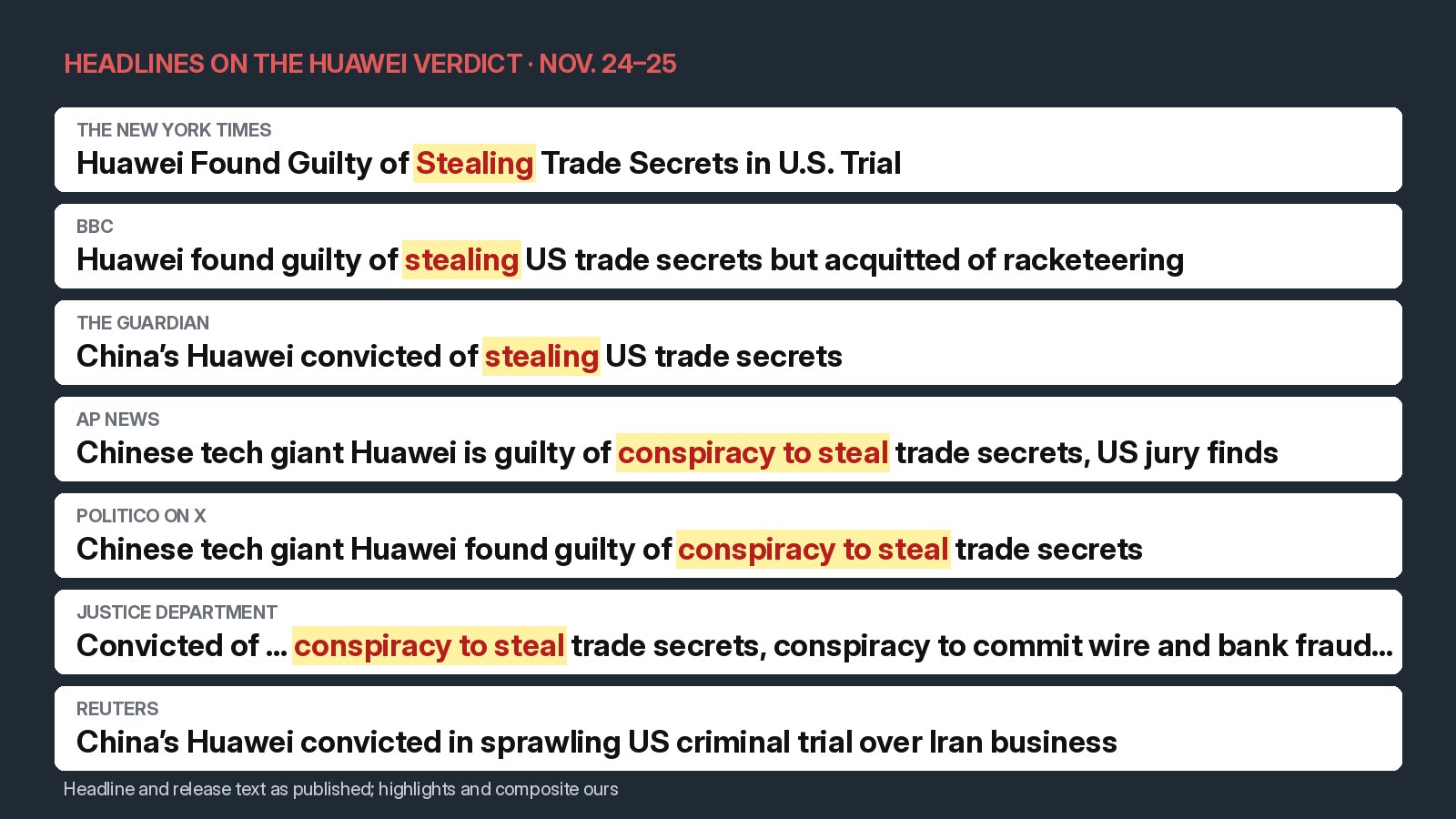
The Justice Department lists the trade-secret conviction as a conspiracy count. The New York Times, BBC and The Guardian wrote “stealing”; AP, Politico and the New York Post wrote “conspiracy.” Huawei was acquitted of racketeering.
Jury convicts Huawei on 10 of 12 counts, including conspiracy to steal trade secrets; 61 of 98 trade-secret headlines did not say “conspiracy”
Created: 2026-11-25T06:43:07-05:00 (America/New_York)
Last updated: 2026-11-25T06:43:07-05:00 (America/New_York)
The Justice Department lists the trade-secret conviction as a conspiracy count. The New York Times, BBC and The Guardian wrote “stealing”; AP, Politico and the New York Post wrote “conspiracy.” Huawei was acquitted of racketeering.
The short version
A federal jury in Brooklyn convicted Huawei and three subsidiaries on Nov. 24 of conspiracy to steal trade secrets, bank and wire fraud, conspiracy to violate Iran sanctions, sanctions violations and money-laundering conspiracy, the Justice Department says. Huawei was acquitted of racketeering conspiracy and obstruction conspiracy. Sentencing is set for Sept. 14, 2027. Huawei says the remaining charges lack merit.
Of 98 Google News headlines that mentioned trade secrets, 61 did not use the word “conspiracy,” and 49 of those said Huawei stole them or was guilty of theft, including The New York Times, BBC and The Guardian; 37 used “conspiracy.” Twenty-four headlines mentioned the racketeering acquittal.
What the jury decided, Nov. 24
- The counts of conviction: “The jury convicted Huawei and three subsidiaries of conspiracy to steal trade secrets, conspiracy to commit wire and bank fraud, wire fraud, bank fraud, conspiracy to defraud the United States, conspiracy to violate the International Emergency Economic Powers Act (IEEPA), substantive violations of IEEPA, and money laundering conspiracy” (Justice Department release). The subsidiaries are Huawei Device, Futurewei Technologies and Huawei Device USA.
- The acquittals: The jury found Huawei guilty on 10 of 12 counts and cleared it of conspiracy charges tied to racketeering and obstruction of justice (Bloomberg Law; BBC). The Justice Department’s release lists the counts of conviction and does not mention the two acquittals.
- The prosecution’s description: The department’s release says the trial proved Huawei “stole proprietary information” about a T-Mobile testing robot and copied Cisco router source code, among other examples. Those are the prosecution’s descriptions of trial evidence; the trade-secret count the jury returned is a conspiracy count.
- Huawei’s response: Huawei said the racketeering acquittal “confirms that these allegations lack factual basis” and that the remaining charges are “equally without legal or factual merit,” adding that the trade-secret disputes cited were civil matters resolved over two decades (Huawei statement). Its lawyer told the BBC the racketeering count was “a significant overreach.”
- Next: Sentencing is set for Sept. 14, 2027; the companies face fines, forfeiture and restitution (Justice Department). The trial ran about 11 weeks by Bloomberg Law’s count; the department calls it a three-month trial.
The headline count
- The count: Three signed-out Google News searches (U.S. edition, past two days) returned 183 distinct headlines on the verdict from 173 outlets. Ninety-eight mentioned trade secrets. Of those, 61 did not use the word “conspiracy,” and 49 of the 61 said Huawei stole trade secrets or was guilty of “theft”: The New York Times (“Huawei Found Guilty of Stealing Trade Secrets in U.S. Trial”), the BBC, The Guardian, The Telegraph, The Verge, Courthouse News and DW among them; the other 12, such as CNBC’s “…over fraud and trade secrets,” named the subject without a verb. Thirty-seven used “conspiracy” or “conspiring”: AP (“Chinese tech giant Huawei is guilty of conspiracy to steal trade secrets, US jury finds”), CNN, PBS and Al Jazeera among them. Twenty-four headlines mentioned the racketeering acquittal; 44 mentioned Iran; 42 mentioned fraud.
- Why it matters: Conspiracy to steal trade secrets is a separate crime from the theft itself: it requires an agreement to steal and a step toward it. A reader of “found guilty of stealing” would conclude the jury convicted on theft. The same outlet can do both: AP’s article page is headlined “Huawei is convicted in US of stealing trade secrets” while its first sentence says “conspiring to steal” (AP). This is a precision problem, not a partisan one.
- Google’s placement: Google News’s U.S. feed carried CNN’s “US court convicts China’s Huawei for fraud, conspiring to steal trade secrets, in sprawling trial over Iran business” at No. 10, the only verdict cluster in the Top, U.S., World or Business feeds we pulled. Its five headlines: CNN and NBC News used “conspiring” or “conspiracy,” The New York Times “stealing,” and Reuters and Time named no trade-secret verb. On the trade-secret wording, Google’s cluster was more precise than the coverage overall.
- On X: The New York Times posted that the jury “found that the Chinese telecommunications giant Huawei stole trade secrets and evaded sanctions against Iran,” drawing about 633,000 views (post). BBC World’s “Huawei found guilty of stealing trade secrets but aquitted of racketeering” [sic] drew about 601,000 views (post). Politico’s “found guilty of conspiracy to steal trade secrets” drew about 30,000 (post). We did not see a Community Note on any of them in the data returned.
Questions worth asking
- Which specific trade secrets did the jury find were the object of the conspiracy, and will the verdict form be made public?
- Will Huawei, which says the trade-secret disputes were resolved as civil matters, seek to set aside the verdict before sentencing?
- Will outlets that wrote “stealing” update their headlines to match the count of conviction?
How outlets framed it
Outlet headlines from our scout and searches — their words, not ours.
Nov. 25, 6:40 a.m. ET: the Huawei verdict
Of 98 headlines that mentioned trade secrets: 61 without “conspiracy” (49 of them saying “stealing” or “theft”), 37 with it. Representative headlines, their words:
- “Stealing” or “theft” (49 of the 61 without “conspiracy”): The New York Times, “Huawei Found Guilty of Stealing Trade Secrets in U.S. Trial”; BBC, “Huawei found guilty of stealing US trade secrets but acquitted of racketeering”; The Guardian, “China’s Huawei convicted of stealing US trade secrets”; The Telegraph, “China’s Huawei found guilty of stealing trade secrets in landmark trial.”
- “Conspiracy” (37): AP, “Chinese tech giant Huawei is guilty of conspiracy to steal trade secrets, US jury finds”; CNN, “US court convicts China’s Huawei for fraud, conspiring to steal trade secrets, in sprawling trial over Iran business”; PBS, “U.S. jury finds Chinese tech giant Huawei guilty of conspiracy to steal trade secrets, bank fraud.”
- Without trade secrets: Reuters, “China’s Huawei convicted in sprawling US criminal trial over Iran business”; WSJ, “China’s Huawei Convicted of Fraud in U.S. Criminal Trial”; Yahoo Finance, “US Court Found Huawei Guilty, But It Escaped The Most Serious Charge.”
How we counted: Google News search (signed out, U.S. edition) on Wednesday, Nov. 25, about 6:40 a.m. ET, past two days, duplicates removed by outlet and title; each headline was sorted by the words it used. Google section placement is from the Top, U.S., World and Business RSS feeds fetched about 6:34 a.m. ET. X figures were read from public X search about 6:50 a.m. ET.