“All Their News,
Made Fit to Print”

Byadmin
Jensen Huang resigns as Nvidia CEO; senators ask him and Commerce Secretary Lutnick to testify
Nvidia says Huang resigned. Of 164 headlines, 75 said he resigned, 27 called it an ouster, firing or fall, and four were “last hours” portraits. None mentioned Singapore’s Oct. 30 statement that it never investigated Alice Huang.
Jensen Huang resigns as Nvidia CEO; senators ask him and Commerce Secretary Lutnick to testify
Created: 2026-11-12T09:30:00-05:00 (America/New_York)
Last updated: 2026-11-24T03:36:46-05:00 (America/New_York)
Day 3 in the news · ran Nov. 13, Nov. 14, Nov. 15
The short version
Nvidia’s board announced Nov. 12 that Huang resigned as CEO, president and director, effective immediately; CFO Colette Kress became interim CEO and Harvey C. Jones the first board chair. Senate Banking asked Huang to testify Dec. 3 and Commerce Secretary Howard Lutnick Dec. 10; the House Foreign Affairs chairman set a Dec. 1 interview.
Nvidia’s word was “resigned”; 27 of 164 headlines said ousted, fired or a fall. None mentioned Singapore’s formal denial that it had investigated Alice Huang, which the Journal’s Oct. 30 story had attributed to Singapore officials.
Nvidia’s board announced Thursday morning, Nov. 12, that Huang had resigned as president, chief executive and a director, effective immediately. CFO Colette Kress is interim CEO while remaining CFO, and director Harvey C. Jones becomes the company’s first board chair. The release quotes Kress and Jones but not Huang (Nvidia; CNBC). Bloomberg’s headline says the board “ousted” him (Bloomberg); Nvidia’s own word is “resigned.” The Journal had reported Nov. 11 that the board was preparing to oust him.
What the record shows (Nov. 12–13)
- Congress: Senate Banking Chairman Tim Scott, R-S.C., sent letters Thursday asking Huang to testify Dec. 3 and Commerce Secretary Howard Lutnick Dec. 10, saying the committee would use “all tools at our disposal, including subpoenas” if Huang did not appear voluntarily. A Lutnick spokesperson told NBC he “has proactively agreed to appear voluntarily” (NBC News; CNBC).
- House: House Foreign Affairs Chairman Brian Mast, R-Fla., said Huang “has agreed to come” and asked for a closed-door, transcribed interview on Dec. 1, with a subpoena if Huang did not confirm by Friday evening, Nov. 13 (NBC News; CNBC).
- Singapore: On Oct. 30, the Singapore Police Force said that “neither the Singapore Government nor its officials” told the Journal that they were concerned about Alice Huang or had investigated her, and that “there were no such investigations conducted in respect of Alice Huang.” It published the Journal’s question and its reply. The same statement says investigations into Megaspeed, the Singapore company Alice Huang has been linked to, “are ongoing” (Singapore Police Force).
- An independent technical claim: On Nov. 12, AI researcher Will DePue published an analysis of public model weights. It finds that six models from DeepSeek, Moonshot AI, MiniMax and Ant Group carry patterns matching Nvidia Blackwell chips, which need a U.S. license for export to China. He writes that the method “does not establish where the chips were located, how access was obtained, or whether export controls were violated.” On Nov. 13, the Institute for Progress posted a public GitHub check that reproduced DePue’s starting-weight patterns for 3 of the 11 models in the study — DeepSeek-V3-Base, DeepSeek-V4-Flash and MiniMax-M3 — and said it could not test the other 8. We have not seen a response from the labs or Nvidia (Unemployment Labs).
- A coordination claim we could not support: A widely shared post by the pseudonymous X account @Dream1984Tube argues that people tied to the AI company Anthropic drove the pile-on against Huang (X). The records it cites that we checked, including the Singapore statement, are real. We found no evidence of coordination, and the post names reporters as “sources” without showing any. Anthropic has publicly argued for tighter chip export controls on China, which Huang opposed; that is context, not proof.
Correction, Nov. 17: An earlier version of this page said DePue’s analysis “has not been independently reviewed.” That was incorrect. On Nov. 13 the Institute for Progress posted a public GitHub check that reproduced his starting-weight patterns for 3 of the 11 models in the study — DeepSeek-V3-Base, DeepSeek-V4-Flash and MiniMax-M3 — and said it could not test the other 8.
How we counted: two Google News searches for Huang and his resignation at about 6:45 a.m. ET Friday, duplicates removed by outlet and title, keeping headlines from 5 p.m. ET Wednesday onward: 164 headlines. 75 said he resigned or stepped down; 12 said he was ousted, fired or forced out and 15 called it a fall, downfall or implosion (27 together); 4 were “last hours” or “last days” portraits (Bloomberg, Fortune, The Information and the Australian Financial Review); 33 mentioned an affair and 17 mentioned spying. No headline mentioned Singapore’s denial. Two mentioned Singapore at all (The Guardian on Megaspeed; CNBC on why Singapore keeps turning up).
Most of the coverage reported the resignation straight. What changed was the register: the “oust” language of Wednesday’s reporting carried into Thursday night, and several outlets moved on to portraits of Huang’s final hours, including Bloomberg’s “‘I’m a Piece of Sh–’: Jensen Huang’s Last Hours as Nvidia CEO” and Fortune’s “a broken man heard saying things like ‘whatever’ and ‘I don’t care.’” The spy allegation concerns Alice Huang, not Jensen Huang, and China denies it. Singapore’s on-record statement that it never investigated her, which the Journal’s Oct. 30 story had attributed to Singapore officials, did not appear in any headline we counted.
Update, Nov. 15, evening: the “conspiracy theories” line and the Singapore account
Taylor Lorenz and Brian Chau flagged how The New York Times and The Wall Street Journal handled two contested claims in the Huang coverage. We read the Times text.
In the Nov. 13 DealBook newsletter, “A Scorecard for Huang’s Exit From Nvidia,” The Times wrote that some in Silicon Valley “rushed to his defense,” quoting Andreessen Horowitz partner Martin Casado, then added, in parentheses: “Others, like the former Trump administration official David Sacks, have started spreading conspiracy theories.” The words “spreading conspiracy theories” link to Sacks’s Nov. 13 post, in which he quoted CNN correspondent Natasha Bertrand’s report that “the intelligence collected on her to date does not prove that she was acting as a spy for Beijing,” and listed caution attributed to the attorney general (“no conclusions reached”), the CIA (“not yet convinced”), the director of national intelligence (“not entirely accurate and over-torqued”), and incoming House Intelligence Chairman Jim Himes (“today, at least, I don’t know”). The same post also asked who leaked a classified memo and called for an investigation. Lorenz wrote that the Times claims Sacks is “spreading conspiracy theories,” “but when u click through and see what this alleged conspiracy theory is it’s literally just him accurately citing CNN’s reporting.” The CNN citation checks out. The post is not only a CNN citation; it also treats the leak as a crime and asks who did it.
On the Journal: Chau wrote that the “WSJ fabricated statements from the Singapore government.” The Singapore Police Force’s Oct. 30 clarification, which we read, says the Journal’s article “Chinese Executive Close to Nvidia CEO Suspected of Giving China Information” “cites sources that Singapore officials were concerned with Alice Huang’s close ties” to Jensen Huang “or her being an alleged Chinese intelligence source, and had separately investigated her ties to China.” Singapore’s response: “neither the Singapore Government nor its officials said this. And there were no such investigations conducted in respect of Alice Huang.” The same statement says investigations into Megaspeed “are ongoing” and reprints the Journal’s query and the government’s reply. “Fabricated” is Chau’s word; the official record is a formal denial of the attribution. We still have not found a Journal correction or response. This denial was already in our Nov. 13 update; of the 164 headlines we counted that morning, none mentioned it.
Also on the record: Bloomberg reported Nov. 13 that Manhattan prosecutors are examining whether entities linked to Alice Huang helped smuggle Super Micro products to China; Megaspeed, her former company, is under a separate Justice Department smuggling probe and denies wrongdoing. Neither is a finding that she was a spy.
What X users are checking
- Whether the “spy” label is on the record. David Sacks, a former Trump administration official, set out on-record caution from the attorney general (“reached no conclusions”), the CIA and Rep. Jim Himes, and noted the spy stories rest on anonymous officials. We checked the Blanche quote against CNN. No official has said on the record that Alice Huang was a spy.
- Whether The New York Times fairly called that “spreading conspiracy theories.” Taylor Lorenz showed the link goes to Sacks citing CNN; our Nov. 15 check confirmed the CNN citation (see the Nov. 15 evening update).
- Whether The Wall Street Journal’s Singapore account holds. Brian Chau called it fabricated; the record is Singapore’s formal Oct. 30 denial that its officials said it or investigated her. “Fabricated” is his word.
- The other side: Bloomberg’s Super Micro report and Singapore’s note that its Megaspeed investigations “are ongoing.”
What questions the legacy media missed
- What exactly did Singapore deny, and did the Journal respond? Singapore denies saying it suspected or investigated Alice Huang, and says the Megaspeed investigation continues. We found no Journal correction or response in public coverage. Open.
- Resigned or ousted? Nvidia’s release says “resigned.” Bloomberg and the Journal say the board pushed him out. Both can be true; few headlines said which source they were relying on.
- Did banned chips reach Chinese labs, and how? Bloomberg reports that a firm linked to Alice Huang procured banned Nvidia chips in China, and DePue’s analysis finds Blackwell patterns in Chinese models. Neither says Jensen Huang knew. That is the question for the Dec. 3 and Dec. 10 hearings.
- Did the Times fairly call Sacks’s post a conspiracy theory? DealBook linked “spreading conspiracy theories” to a Sacks post that quoted CNN’s reporting that intelligence has not established Alice Huang was a spy, and cited on-record or attributed caution from the attorney general and others. The same post also asked who leaked a classified memo. Open.
Primary sources
- The New York Times, DealBook (Nov. 13): “A Scorecard for Huang’s Exit From Nvidia”
- David Sacks on X (Nov. 13): the post DealBook linked as “spreading conspiracy theories”
- Taylor Lorenz on X (Nov. 14): the Times link goes to Sacks citing CNN
- Brian Chau on X (Nov. 13–14): “WSJ fabricated statements from the Singapore government”
- Singapore Police Force (Oct. 30): clarification statement on the Wall Street Journal’s article
How outlets framed it
Outlet headlines from our scout and searches — their words, not ours. Opinion and analysis pieces are labeled.
- Bloomberg (Nov. 12): “Nvidia’s Huang Ousted by Board After Reports of Three Affairs”
- Bloomberg (Nov. 12): “‘I’m a Piece of Sh–’: Jensen Huang’s Last Hours as Nvidia CEO”
- Fortune (Nov. 13): “Inside the dismal final days of Jensen Huang: a broken man heard saying things like ‘whatever’ and ‘I don’t care’”
- The Information (Nov. 13): “Sex, Lies and AI Chips: Jensen Huang’s Last Days as Nvidia CEO”
- The Washington Post (Nov. 13): “Jensen Huang resigns as Nvidia CEO after affair with alleged spy”
- AP (Nov. 12): “What we know after Jensen Huang resigns as Nvidia CEO”
- The Guardian (Nov. 12, opinion): “Jensen Huang was a busted flush at Nvidia – he had to go”
More on Jensen Huang
- Nov. 10: Trump says the FBI is looking into Huang’s affair with an alleged Chinese spy
- Nov. 11: A second reported relationship, and the Journal’s “preparing to oust” report
- Nov. 12: Huang resigns; Congress asks him and Lutnick to testify (this article)
- Nov. 13: Bessent blames Lutnick’s Commerce Department over Megaspeed
- Nov. 15: Lutnick’s job in question after the Times chip-rules report
- Nov. 15: Allies push a comeback; the board says it is not considering one
- Nov. 16: Commerce and Justice publish the Megaspeed probe timeline
- Nov. 17: Huang offers to return; the board says no on earnings day
- Nov. 20: The Times reports Huang “made humiliation routine”
- Nov. 20: Reuters reports an SEC accounting inquiry
- Nov. 20: Trump says Huang should apologize and return
- Nov. 21: California’s attorney general says his probe covers criminal law
- Nov. 22: The Times reports Alice Huang was in touch with China’s spy agency
- Nov. 23: Nvidia reinstates Huang
- Nov. 24: Commerce puts Megaspeed on the Entity List; headlines said “Nvidia,” the rule does not
- Nov. 25: Huang tells staff the government did not bring him back; headlines led with therapy
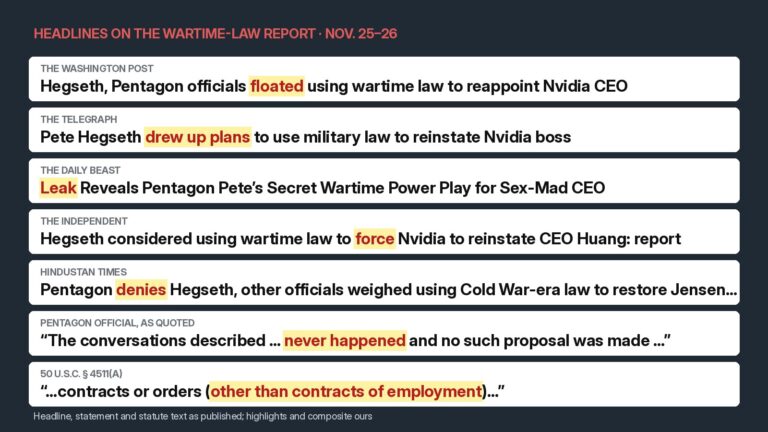
- Nov. 26: The Post reports the Pentagon floated a wartime law to restore Huang; the Pentagon says it “never happened”
Editor’s note, Nov. 24: This article was split out of our running Nvidia coverage so each news event has its own page. Its text first ran there as the Nov. 13 update, with the Nov. 15 evening accuracy check and the Nov. 16 X checks; headline counts and quotes are unchanged. Related articles are linked above and on the Jensen Huang topic page.

[…] Nov. 12: Huang resigns; Congress asks him and Lutnick to testify […]
[…] What happened next: Nvidia announced Huang’s resignation the next morning, Nov. 12. That is a separate article: Jensen Huang resigns as Nvidia CEO. […]
[…] Nov. 12: Huang resigns; Congress asks him and Lutnick to testify […]
[…] Nov. 12: Huang resigns; Congress asks him and Lutnick to testify […]
[…] Nov. 12: Huang resigns; Congress asks him and Lutnick to testify […]
[…] Nov. 12: Huang resigns; Congress asks him and Lutnick to testify […]