“All Their News,
Made Fit to Print”

Byadmin
Tina Peters releases her own 60 Minutes interview audio and sets it against the aired cut
CBS cast her as “unapologetic” in a segment on Trump’s push to free her. Her edit of the unaired audio says answers were clipped. It is her tape and her cut; CBS has not responded.
Tina Peters releases her own 60 Minutes interview audio and sets it against the aired cut
Released by: Tina Peters (@realtinapeters)
Created: 2026-10-29T04:44:00-04:00 (America/New_York)
Last updated: 2026-10-29T06:11:00-04:00 (America/New_York)
Living page — updated in place as new primary drops land.
The short version
Tina Peters released an eight-and-a-half-minute comparison of her own interview audio with the 60 Minutes broadcast, showing answers that continued beyond the aired clips. She says CBS used only a small fraction of a nearly two-hour interview. The comparison also raises omitted context about two interviewees’ candidacies and her reasons for copying election-system files.
This is source material released by the interview subject, rather than a separate journalist’s investigation. Its value is that readers can compare the audio with CBS’s published transcript instead of relying only on a network’s finished edit. The account below follows those comparisons and the court record, making the editorial choices visible and giving Peters’s explanation room to be heard.
On Oct. 25, 2026, 60 Minutes aired Bill Whitaker’s report on President Trump’s campaign to free former Mesa County Clerk Tina Peters, whose prison sentence Gov. Jared Polis commuted in May, and on federal money that later flowed back to Colorado. Peters appears in the segment for short stretches. She says the sit-down ran nearly two hours and that CBS used 1 minute 17 seconds of it.
Shortly after midnight on Oct. 29 she posted an 8½-minute video labeled part one. It alternates clips marked “AIRED” with cards and audio marked “Full sit-down audio. Not aired.” The audio is hers; so are the edit, the captions and the card wording. CBS has not released its full recording and had not responded publicly as of early Oct. 29.
Set against CBS’s own published transcript, her tape does show answers that continued past where the broadcast stopped, and an omission about two interviewees’ candidacies that checks out. Her strongest splice claim rests on a caption, not on audio. Her core claim, that the 2021 system update unlawfully destroyed election records she says she imaged the server to preserve, has never been put to a jury: the judge excluded it as irrelevant, the appeals court agreed, and the Secretary of State calls the claim false.
Research quality: Primary audio from the subject, set against CBS’s published transcript and court and state records. Provenance is one-sided: Peters released and edited the unaired audio, and the continuity of each clip cannot be confirmed without CBS’s full recording. The trial-fairness section relies on the Court of Appeals opinion, her own Colorado Supreme Court petition, the federal docket, and Colorado Sun and Colorado Newsline trial coverage. We did not review trial transcripts.
Related: the same week, the Department of Homeland Security posted its own uncut 60 Minutes interview with its general counsel to contest a separate segment, and 60 Minutes posted an extended cut. Subjects releasing their own tape against a 60 Minutes edit is becoming a pattern.
Why she did it
The jury never heard her motive. Her open question: if the public can’t see what an update installs or erases, who would know if a server had been tampered with? Officials point to certification, hash checks and paper audits.
- Her account. On Lara Logan’s Going Rogue podcast (July 2, 2026), she said the April 2021 Grand Junction city election made her suspicious, so before the May “trusted build” (“a wipe,” she says) she “backed up the election files … because I’d taken an oath.” Her complaint: “There’s too much secrecy … in the proprietary, they call it software, in these machines. And nobody’s allowed to see it.”
- The update. A trusted build overwrites county voting computers with the state’s “golden image” of certified software; the Secretary of State says it comes straight from a federally accredited test lab, only state staff install it, and it is checked against the lab’s hash values. In Mesa on May 25–26, 2021, one state employee and three Dominion staff did the work.
- What outsiders can check. The state posts certification reports, withholding some documents for security or proprietary reasons, and audits paper ballots after every election; it says none since 2017 has found a wrong outcome. But the public can’t attend a trusted build, and we found no published hash values for Colorado’s software versions.
- The known weaknesses. In 2022 the federal agency CISA confirmed nine flaws that J. Alex Halderman and Drew Springall found in Dominion’s ImageCast X ballot-marking device, including a way for malware to spread from a county’s central server and a hash check that relies on the machine vouching for itself. CISA saw no evidence of exploitation in any election, it tested Georgia’s version, and no one has shown votes were changed in Mesa; Halderman counts Colorado’s breach among those that raise the risk.
- Her experts vs. officials. Report 1 (Doug Gould, 2021) counted 28,989 files deleted in the update, 695 of them logs it says federal standards required kept; Report 3 (Walter Daugherity and Jeff O’Donnell, 2022) alleged “unauthorized and illegal manipulation of tabulated vote data.” The Secretary of State calls the records claim false, saying logs aren’t election records under state law; District Attorney Dan Rubinstein traced Report 3’s anomaly to an elections manager’s actions and found no evidence the counts were wrong, a conclusion her lawyer disputes.
Aired vs. her tape, clip by clip
Left: the CBS transcript. Middle: what her video adds (audio unless marked as a caption). Right: what we could check against court records and other sources.
| Moment | What CBS aired | What her tape adds | What we could check |
|---|---|---|---|
| “Ends justify the means” | Narration: “When we met with Tina Peters in August, she was unapologetic and argued the ends justify the means.” | Caption: “She never said that.” | It is Whitaker’s narration, not a quote attributed to her. Whether it fairly sums up the interview can’t be judged without the full tape. |
| The “wipe” | Peters: the records “were wiped from the system.” Narration: a “routine system update.” Matt Crane, Colorado County Clerks Association director: required records had been backed up by her staff. | Audio: before-and-after images; “29,000 election records that were required by federal law to be retained for 22 months … were erased or overwritten.” Caption: Crane’s wife worked at Sequoia, later taken over by Dominion; CBS did not say so. | Crane’s wife, Lisa Flanagan-Crane, did work for Sequoia and later Dominion; an Arapahoe County ethics review cleared Crane of any conflict in 2013. The “more than 17 years” figure is unverified. In a 2021 court brief, the Secretary of State called the destruction claim “false and without merit,” saying nothing in her report was an election record as state law defines it. On air she cites “52 U.S.C. 70201”; the 22-month federal retention law is 52 U.S.C. § 20701. |
| “60 lawsuits” | Whitaker: “Show me the evidence that the paper ballot results differed from the computerized results.” After her answer: more than 60 lawsuits alleging 2020 fraud “were either dismissed or withdrawn.” | Caption: the line is “his, from earlier in the interview,” cut in while she was still answering. | Where the question fell in the sit-down can’t be checked without CBS’s raw tape. She does not dispute the lawsuit count itself. |
| “Did you break the law?” | “Did you break the law?” / “… you’re asking me if I broke the law? They said I broke the law.” / “You were prosecuted by a Republican district attorney.” / “Doesn’t matter.” | Audio: “I didn’t break the law … Having Conan Hayes in there was not breaking the law. Turning the cameras off was not breaking the law … I needed to find out if these machines were secure, and I found out that they’re not.” Also: the jury “was not allowed to hear the evidence,” with “41 motions that were denied.” | Seven guilty verdicts stand; she was acquitted on three counts. Courts have so far rejected her claim that the jury “was not allowed to hear the evidence.” The “41 motions” count is hers and unconfirmed. Her May 2026 clemency statement said she “misled the Secretary of State”; her filings concede that but call it lawful. See “What the jury heard, and what it didn’t.” |
| Cameras | “Why turn off the security cameras?” / “It was not against the law.” | Audio: cameras are “supposed to be on 60 days before an election and 30 days after”; this was an update, “not during an election.” | Her description of the camera requirement is unverified. The appeals court’s account differs: Mesa County’s practice was to keep the cameras on at all times, and she had them switched off a week before the update. The court cited the shutdown as evidence that she knew the access was unlawful. |
| Who was in the room | “You gave an outsider fake credentials.” No answer is heard; the next line is “Did you break the law?” | Audio: “I was the elected clerk, a custodian, not a trespasser”; under “election rule 20.5.3B” a person could be in a secure area if accompanied; Hayes was “accompanied the whole time.” To Whitaker’s “you used someone else’s…”: “That is not true.” | Her citation doesn’t match the current Rule 20, where secure-area access falls under 20.4; the 2021 text is unverified. Prosecutors and the appeals court say Hayes entered on Gerald Wood’s badge, and her own May 2026 petition says she introduced him to state staff as Wood. The conspiracy-to-impersonate verdict stands. Her denial on tape doesn’t say which part she disputes. |
| “Why is your conviction unjust?” | “What makes you think your conviction was unjust?” / “Because I do believe these machines can be breached.” | Caption: her words were part of a sentence siding with Kamala Harris that machines can be breached, followed by a short Harris clip she labels 2018. Audio of Whitaker repeating the question: “because the jury wasn’t able to hear the whole story.” | Her repeated-question audio is real and was not aired. The “Harris” sentence appears only as a caption, not as audio. This is her strongest splice claim, and it stays unproven either way until CBS releases its tape. |
| “My answer is no” | “Can people trust these machines? Can they really trust these machines? My answer is no.” | Audio continues: “You’re trusting a computer …” and argues for a voter-verified paper ballot counted by a bipartisan team. | Her audio shows a reason followed the “no.” Whether the cut was for time or for meaning is a judgment call. |
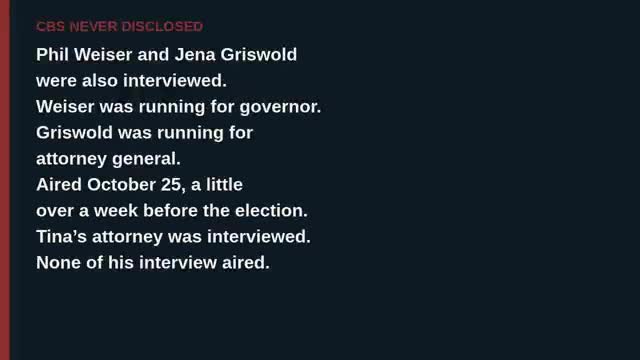
| What viewers weren’t told | Phil Weiser and Jena Griswold identified by office only. “The courts were in the middle of reconsidering her sentence.” | Caption: Weiser was running for governor and Griswold for attorney general; the segment aired about a week before the election; her attorney was interviewed and none of it aired. | Accurate on the candidacies: Weiser won the June 30 Democratic primary for governor and Griswold the Democratic primary for attorney general. CBS’s line on her sentence omits the reason: the Court of Appeals found the trial judge had punished protected speech. The attorney claim is unverified. |
What the jury heard, and what it didn’t
Peters’ central complaint is procedural: the jury, she says, never heard why she acted.
- The verdict. In August 2024 a Mesa County jury convicted her on 7 of 10 counts, including attempting to influence a public servant, conspiracy to commit criminal impersonation and official misconduct, and acquitted her of identity theft, criminal impersonation and a second conspiracy count. The Court of Appeals later threw out her sentence of nearly nine years; Gov. Polis commuted it in May 2026.
- Her claim. On her tape she says the jury “was not allowed to hear the evidence” and that “41 motions” were denied (her count; unconfirmed). At trial she declined to testify, telling the judge, “I have been prevented from providing a defense for myself.”
- What was kept out, and why. Excluded: her motive of preserving records under federal law (52 U.S.C. § 20701); how the voting equipment worked; her belief that Hayes was a government informant; her records investigation; a second recording of the planning meeting; cross-examination about an alleged scheme to erase evidence; and jury instructions on public-duty and federal-immunity defenses. Judge Matthew Barrett ruled the evidence irrelevant to the charged acts and likely to confuse the jury, and held that no law let a clerk use deception to investigate.
- The appeal. On April 2, 2026, the Court of Appeals unanimously upheld those rulings: the records had already been backed up, it said, so preservation had “no bearing” on the charges, and § 20701 requires keeping records, not investigating. Two claims, on expert reports and a Dominion subpoena, were not decided on the merits. It ruled for her on one point: Barrett’s “charlatan” and “snake oil” remarks punished protected speech, so the sentence had to be redone.
- Where it stands. The Colorado Supreme Court denied review on Sept. 21, 2026; her attorney says a U.S. Supreme Court petition is coming. Because the evidence was excluded, no jury or court has decided whether the 2021 update destroyed records federal law required kept; the Secretary of State says it did not.
- The May 2026 statement. Her clemency application, written in prison, said she “misled the Secretary of State” and that it “was wrong.” Colorado law does not require an admission for clemency, but Polis said in March that a successful application would need “appropriate contrition, apology,” and his commutation letter cited her “taking responsibility.” While it was pending, she swore in a Jan. 29 court declaration that other inmates had assaulted her five times and wrote, “They want me to die in prison”; we have not verified the assault claims.
- Her own record. Her filings concede the deception but call it lawful: her May 2026 petition to the state Supreme Court says she introduced Hayes to state staff as Gerald Wood, with Wood’s consent, and argues federal and state law authorized her to have an expert watch the update. On that account, the apology and her “not breaking the law” answer to CBS are consistent. Two loose ends: on tape, her “That is not true” answers a question that was cut off, so what she denied is unclear; and a July post on her account said she had refused “demands to recant.”
Where things stand
- Verified: Weiser’s and Griswold’s candidacies; the Crane–Sequoia/Dominion family link; the April 2026 appeals ruling (convictions upheld, sentence reversed); the May commutation; the Sept. 21 denial of review.
- Verified from her audio: several answers ran past where CBS cut, including her full denial that she broke the law, her camera and access explanations, and a second “unjust” answer.
- Contested: whether excluding her motive and records evidence was fair; courts have said yes so far. Undecided by any jury or court: whether the 2021 update destroyed required records.
- Doubtful: her Rule 20.5.3(b) citation; the “more than 17 years” Sequoia tenure; the “41 motions” count, which is hers alone.
- Unproven either way without CBS’s tape: the “Harris” sentence splice; where Whitaker’s “60 lawsuits” question fell; whether her attorney’s interview exists.
Chronology of drops
- 2021-05-25 — Mesa trusted build — May 25–26; one state employee, three Dominion staff. An image of the server had been taken May 23.
- 2022-06-03 — CISA advisory on ImageCast X — Nine vulnerabilities; “no evidence” of exploitation in any election.
- 2024-08-09 — Peters declines to testify — Tells the judge she has been “prevented from providing a defense.”
- 2024-08-12 — Verdict — Guilty on 7 of 10 counts, acquitted on 3.
- 2025-03 — Justice Department statement of interest — In her federal habeas case; cites concerns about the sentence, the judge’s remarks and bail, and announces a review. We found no published result.
- 2025-12 — Trump pardon; federal habeas dismissed — The Dec. 5 pardon was later held not to reach state crimes; the habeas case was dismissed Dec. 8 on abstention grounds.
- 2026-01-29 — Her sworn declaration from prison — Says she was assaulted five times and asks for bond pending appeal: “They want me to die in prison.” Claims not independently verified.
- 2026-03-04 — Polis sets out what he would look for — To 9NEWS: a successful application would need “appropriate contrition, apology.” The advisory board had already recommended denial twice.
- 2026-04-02 — Colorado Court of Appeals, No. 24CA1951 — Affirms the seven convictions and the evidence rulings; rejects juror-bias and prosecutor-misstatement claims; reverses the sentence because the trial court punished protected speech.
- 2026-05-15 — Polis commutes her sentence — His letter cites her application’s “taking responsibility.” Convictions stand; parole June 1, 2026 to June 1, 2029. Her statement that evening: “I misled the Secretary of State … That was wrong.”
- 2026-05-21 — Her Colorado Supreme Court petition — Concedes she introduced Hayes as Wood; argues federal law made it lawful.
- 2026-07-02 — Peters on Going Rogue with Lara Logan — Ep. 87, about an hour; her account of the images and the update.
- 2026-08 — 60 Minutes sit-down recorded — CBS: “When we met with Tina Peters in August.” She puts the full sit-down at 1 hour 49 minutes.
- 2026-09-21 — Colorado Supreme Court denies review — One-line order in 2026SC332.
- 2026-10-25 7:00 PM ET — 60 Minutes airs “#FreeTinaPeters” — Bill Whitaker, correspondent; transcript published by CBS.
- 2026-10-29 12:41 AM ET — Peters posts part one of her unaired audio — 8:36 video; aired clips set against her audio and captions. · X metrics as of 4:27 AM ET Oct. 29: 12,277 impressions · 652 likes · 315 RTs
Sources
Pointers to originals. We do not close-paraphrase their prose — read the primaries.
- Peters’ video, part one (X) — Primary; her audio and her edit
- CBS: 60 Minutes transcript — Primary; what aired
- CBS: segment page — CBS’s own framing of the story
- Colorado Court of Appeals opinion, 24CA1951 — Convictions affirmed; sentence reversed
- Colorado Secretary of State, April 2, 2026 statement — Seven convictions stand; resentencing ordered
- Colorado Secretary of State, Aug. 12, 2024 verdict release — Verdict
- Colorado Secretary of State, Sept. 23, 2021 brief — State’s rebuttal of the records-destruction claim
- Colorado Election Rule 20 (current) — Compare with her 20.5.3(b) citation
- 52 U.S.C. § 20701 — Federal 22-month retention law
- Colorado Community Media (2013): Crane ethics review — Secondary; wife’s Sequoia role and the conflict complaint
- Colorado Secretary of State: 2026 primary certified — Weiser and Griswold nominations
- Peters’ petition to the Colorado Supreme Court, 26SC332 — Her “complete defense” and juror arguments; hosted on her site
- Colorado Supreme Court order denying review — Sept. 21, 2026
- Colorado Sun: Peters declines to testify — Her “prevented from providing a defense” remark; excluded witness
- Colorado Sun: verdict — Counts, acquittals, the judge’s rulings
- Colorado Newsline: defense rests — Contempt request over excluded topics
- Justice Department statement of interest (Peters v. Feyen, D. Colo.) — Primary; March 2025
- Colorado Politics: 10th Circuit dismisses as moot — June 17, 2026
- NPR: Polis commutes sentence — May 15, 2026
- Gov. Polis’s commutation letter to Peters — Primary; May 15, 2026; “taking responsibility”
- Executive Order C 2026 039 — Primary; convictions unaffected; parole terms set by the parole board
- HB23-1214 (C.R.S. 16-17-102.3, -105) — Primary; applicants claiming innocence need not admit guilt
- Mesa County order filing the judge’s clemency letters — Primary; April 22, 2026; Feb. 8 addendum
- Declaration of Tina Peters, Jan. 29, 2026 — Primary; under penalty of perjury; filed Jan. 30, 2026 in Court of Appeals No. 2024CA1951 as Exhibit 3; hosted on her site; assault claims not independently verified
- Peters on X: May 15 statement — Full text, in her words
- Peters on X: Oct. 25 — “I would have violated law to allow them to delete the records”
- Peters’ X account: July 14 — “demands to recant”
- AP via PBS: Polis on contrition — March 5, 2026
- 9NEWS: Polis commutes sentence — Review of 25 commutations; Polis on contrition
- CNN: Peters released — June 1, 2026; Ticktin: she “could have done it better”; application wording
- KDVR: clemency board recommended denial — June 19, 2026; board twice recommended denial; Taslimi: “performative accountability”
- KOAA: parole conditions — Parole ends June 1, 2029
- The Hill/KDVR: Supreme Court bid — Attorney Peter Ticktin, Oct. 26, 2026
- Going Rogue with Lara Logan, Ep. 87 — July 2, 2026; quotes from the free audio at about 7:25–8:18 and 9:57–10:07
- Going Rogue Ep. 87 audio (Podbean) — Version with ads; timestamps above refer to it
- Colorado Secretary of State: certification and installation overview — Golden images, lab hash values, posting of documents
- Colorado Secretary of State: Democracy Suite 5.13 certification — Test report, test plan, conditions of use
- Secretary of State opening brief, Sept. 22, 2021 — Who attended the trusted build; the records position
- Secretary of State election order, Aug. 17, 2021 — Officials’ account of May 23 and May 25
- NIST: voting software hash releases — Lists Dominion 5.4 versions and 5.12-NV
- CISA advisory ICSA-22-154-01 — June 3, 2022; tested ImageCast X in Democracy Suite 5.5-A
- Halderman: Security Analysis of the Dominion ImageCast X — June 14, 2023, on the unsealed Curling v. Raffensperger report
- Mesa County Report 1 (Gould), via Secretary of State rulemaking comments — Sept. 2021; 28,989 deleted files, 695 logs
- Mesa County Report 3 — March 19, 2022
- Mesa County DA: conclusion on Report 3 — May 19, 2022
- Peters’ lawyer: response to the DA — Randy Corporon; names Report 3’s authors
Open questions
- Will CBS release the full recording or respond to her edit?
- Was “Because I do believe these machines can be breached” her answer to the conviction question, or the back half of another sentence?
- Where in the sit-down did Whitaker’s “60 lawsuits” question fall?
- Was her attorney interviewed for the segment?
- Which version of Election Rule 20 does she rely on for secure-area access?
- What does part two contain?
- Which motions make up her “41 motions” count?
- Will the U.S. Supreme Court take her petition?
- Did the Justice Department’s announced review of her prosecution produce any findings?
Mainstream coverage note
Legacy/mainstream outlets had not covered her rebuttal video as of early Oct. 29. CBS framed the segment around Trump’s pressure on Colorado and federal funding; Colorado Public Radio covered the interview as part of a Peters “media blitz” (https://www.cpr.org/2026/10/26/tina-peters-60-minutes-interview/). Precedent for a release: in February 2025, CBS published an unedited transcript of its Kamala Harris interview after FCC pressure.
Paywall / access notes
- Her video is free on X. The CBS transcript and segment are free on cbsnews.com.
- No paywalled material is used.