“All Their News,
Made Fit to Print”

Byadmin
Protect Democracy guide for state legislators maps post-election fights, from grand juries to certification
Natalie Winters reported the 14-page document, marked confidential but posted publicly by a progressive legislators' network. It urges fast messaging, legal action and, if needed, peaceful mobilization, and asks lawmakers to accept the results.
Protect Democracy guide for state legislators maps post-election fights, from grand juries to certification
By: Natalie Winters (@nataliegwinters)
Created: 2026-10-29T20:58:00-04:00 (America/New_York)
Last updated: 2026-11-03T01:50:00-05:00 (America/New_York)
Living page — updated in place as new primary drops land.
The short version
Natalie Winters surfaced Protect Democracy’s confidential-marked guide for state legislators, then reported on Election Safeguards Response Network memos addressing ballot demands and anti-Trump messaging. The documents discuss advance messaging, election investigations, certification and mobilization. ESRN’s executive director is Norm Eisen; its July memo shares the guide’s phrase about fighting feelings with facts.
Her reporting gives readers the underlying material rather than only an organizer’s public description: a 14-page guide and linked memos available through legislative-resource pages. National mainstream coverage of those documents was absent in the search recorded here. The detailed account traces the language, the organizations distributing it and the practical advice given to elected officials before the vote.
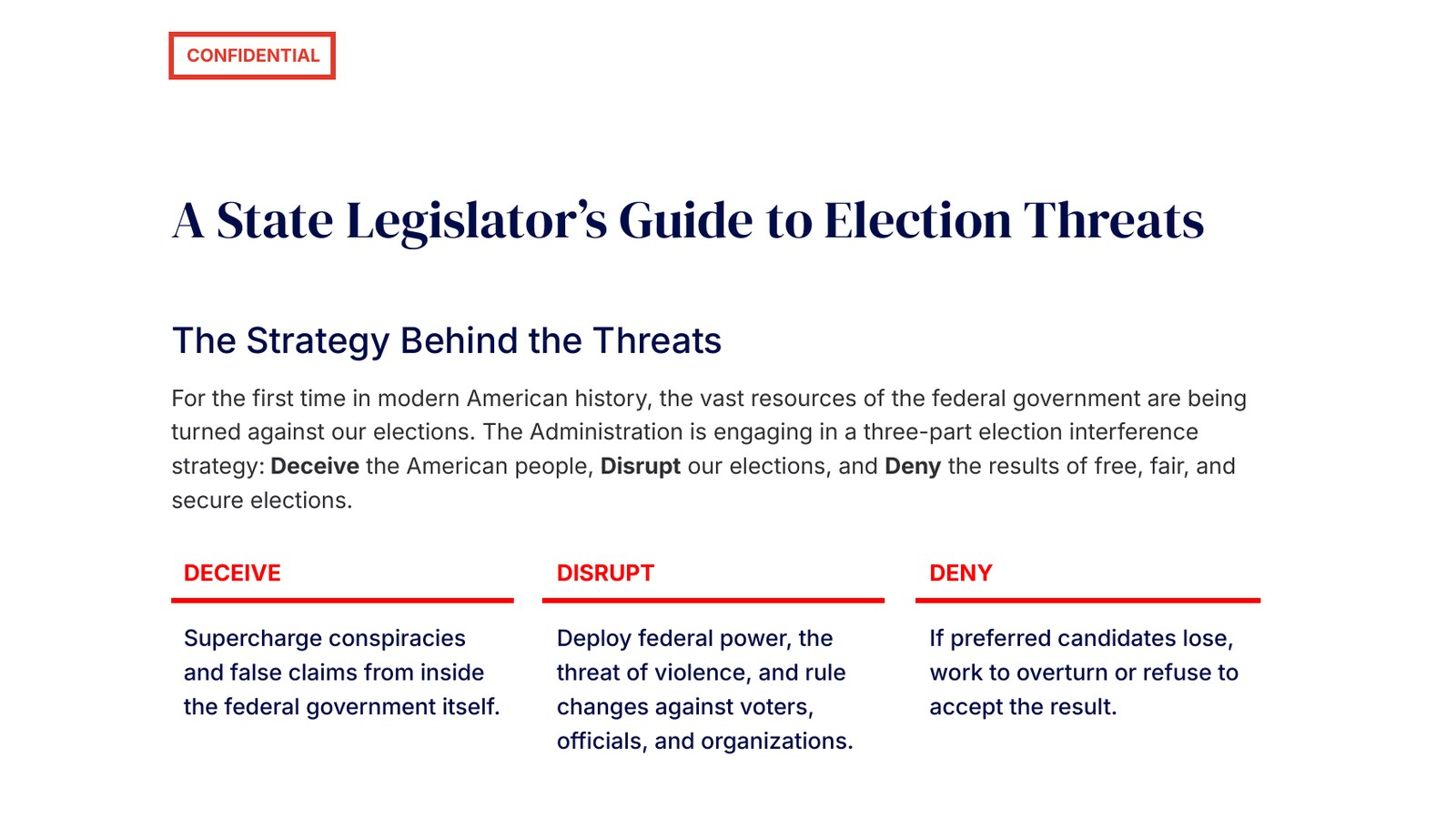
Natalie Winters, co-host of Bannon’s War Room, reported on Oct. 28 on “A State Legislator’s Guide to Election Threats,” a 14-page document from Protect Democracy, a nonprofit co-founded by Ian Bassin and Justin Florence, who both served as lawyers in the Obama White House Counsel’s office. Every page is marked “CONFIDENTIAL.” Even so, the State Innovation Exchange (SiX), a network that works with progressive state legislators, linked the PDF publicly in an Oct. 22 briefing, and it could still be downloaded from SiX’s website on Oct. 29.
The guide begins from its own claim that the federal government is pursuing a three-part strategy to “Deceive,” “Disrupt” and “Deny” in the midterm elections. It then covers seven scenarios: intimidation at the polls; attempts to “nationalize” elections, including an emergency executive order; seizures of ballots, machines or records; criminal investigations of election officials; threats to the count; mass ballot challenges; and refusals to certify. For each scenario it lists key facts, what legal and civic groups have prepared, the leverage legislators have, and suggested messaging.
Much of the advice is about messaging. The guide tells lawmakers to “prebunk” claims before they spread and warns that “online election disinformation peaks in the 10 days before Election Day.” It says investigations of election officials should be framed “immediately as intimidation designed to overturn the election,” and that any seizure of election materials should be made “politically costly.” It describes civic groups preparing “if necessary, mass peaceful mobilizations” in response to an emergency declaration. It also asks legislators to commit “to accepting the results regardless of the outcome” and to concede “promptly when the outcome is settled.”
Glenn Beck amplified the report on Oct. 29, on X and on his radio program, where Winters was a guest. Beck wrote that the guide is about “hijacking the entire post-election process so nobody can audit the results.” The guide says certification “opens the door to recounts, audits, and legal challenges,” but it also asks legislators to commit publicly to opposing efforts to “delay, second-guess, or override certification,” including “partisan reviews” and changes to certification procedures after the votes are cast. That line partly fits his point. In other places his description goes beyond the document; each point is compared with the text below. As of 8:58 PM ET Oct. 29, neither Protect Democracy nor SiX had commented publicly, and no major news outlet had covered the guide.
Research quality: Primary document in hand. The PDF on SiX’s site is 14 pages long, and every page carries the “CONFIDENTIAL” label. All quotes here were checked against it. Winters’ Substack article describes the document accurately. Two phrases in the opening post of her X thread are hers, not the guide’s: “coordinated censorship” (the guide has no language about removing or restricting anyone’s content) and “left-wing group run by Obama White House lawyers.” Still unknown: who received the guide before SiX posted it, what the confidential label was meant to restrict, and whether any legislator has acted on it.
Update, Nov. 3
Added Nov. 3, 2026. On Oct. 30 Winters published a second set of documents. They come from a different network than the Protect Democracy guide described below, but one line is the same.
- Winters reported on Substack and X on Oct. 30 on two memos she said she obtained from the Election Safeguards Response Network (ESRN), dated April 20 and July 16. She wrote that both “were accessible through Local Progress’s public resource page for elected officials, despite their distribution restrictions.” People’s Action identifies Norm Eisen as ESRN’s executive director, and the Brennan Center says it “plays a key role” in the network; ESRN calls itself a “non-partisan convening and collaboration space.” The April 20 memo, “Issue Brief: Wayne County Ballot Demand,” responds to an April 14 Justice Department letter seeking Wayne County, Mich., 2024 ballots and records. It says “Partners on the ground are monitoring developments closely and maintaining open lines of communication with election officials,” offers lines under “What You Can Say” such as “Voters choose our leaders, not the other way around,” and says it “may not be shared outside of the ESRN and is not intended to be shared publicly or with the press.”
- Winters describes this as the partners’ “backchannel” with election officials. The memo’s own phrase is “open lines of communication.” It does not describe any specific contact, request or action by an election official. Winters also notes that Michigan officials disputed the premise of the federal demand. Their April 19 statement says the state’s 2020 voter-fraud convictions show “Michigan’s safeguards work,” and that a court found the allegations in a 2020 civil suit “incorrect and not credible.”
- The July 16 memo, “Message Guidance: Responding to Trump’s Desperate Rant,” advises “DO NOT TAKE THE BAIT. RESIST THE TEMPTATION TO ADDRESS EACH OF HIS CLAIMS OR TO SIMPLY LIST FACTS” and “DO NOT REPEAT CLAIMS ABOUT NON-CITIZEN VOTING, EVEN TO DISPUTE THEM.” Winters calls its suggested lines “anti-Trump talking points.” It also says “when we fight feelings with facts, we lose,” the same words as the Protect Democracy guide (p. 6). Neither document says where the line came from.
- Local Progress’s election-protection page has returned “not found” since the evening of Oct. 30, including on Nov. 3. An Internet Archive copy from 12:08 p.m. ET Oct. 30 lists the Wayne County brief; that copy does not show which link led to the July memo. Both memos still open as Google Docs.
- DataRepublican’s Part 12 of The Democracy Files (Oct. 31) builds on these memos. It argues that ESRN “ultimately calls the shots when it is time to mobilize” and that the trail leads to Norm Eisen, while saying “this does not mean Eisen is the unilateral mastermind.” It shows no document in which anyone orders a mobilization. See our page on that series.
- Beck’s Oct. 29 X post had about 411,000 views by 1:47 a.m. ET Nov. 3, and Winters’ Oct. 30 thread about 180,000. The Rothman Report (Oct. 30) and Rob Maness’s site (Oct. 31) wrote up the documents. We found no mainstream national coverage or fact-check of the guide or the ESRN memos.
- As of 1:50 a.m. ET Nov. 3, ESRN, Norm Eisen, People’s Action, the Brennan Center, Local Progress, Protect Democracy and SiX had not publicly addressed Winters’ reporting on the memos or the guide. Eisen has posted on X since about other election litigation. Winters’ article does not say whether she asked ESRN or Eisen for comment.
What the guide says
- Author and audience: Protect Democracy, writing for state legislators. SiX linked it in an Oct. 22 briefing by Anthony Gad, director of its Shared Tactics & Training program. The briefing says the steps it recommends do not require passing a bill.
- Premise (p. 1): “For the first time in modern American history, the vast resources of the federal government are being turned against our elections.” This is the guide’s own characterization.
- Messaging (pp. 1–2, 6): “prebunk” claims early; “Always verify something is true before taking action”; “when we fight feelings with facts, we lose”; for an emergency order, “Don’t raise this threat proactively” and call it a “fake emergency.”
- Seizures of ballots or machines (p. 8): “Pre-bunk the pretext” and “Make the escalation politically costly. Publicly highlight seizure attempts as desperate and baseless. Demonstrate and lead immediate public outrage.”
- Investigations of election officials (p. 9): the scenario covers investigations used “to pressure compliance in response to unlawful demands.” Its key facts note that Justice Department policy bars overt investigative steps before certification. Its advice: “Frame these investigations immediately as intimidation designed to overturn the election.”
- Grand juries (p. 9): civic groups are described as “educating community members on their role as constitutional gatekeepers who can ask for more evidence and reject improper prosecutions when serving on grand juries.”
- Counting (p. 10): publish recount procedures, “deploy observers for the entire recount process,” and hold “Count Every Vote events that offer peaceful, visible encouragement.”
- Certification (pp. 12–14): “mobilize key civic actors to demand certification and subsequent broad peaceful mobilization if necessary”. The guide says certification “is what opens the door to recounts, audits, and legal challenges.” It asks legislators to oppose “any legislative effort to delay, second-guess, or override certification, including calls for special sessions, partisan reviews, or attempts to change certification procedures after the votes are cast.”
Accepting the results and conceding
- “Commit to waiting until results are clear before declaring victory, and to conceding promptly when the outcome is settled. Encourage colleagues to make the same public commitment, and call on them to accept the results when the count is decisive.” (p. 10)
- “Commit to accepting the results regardless of the outcome.” (p. 14)
- It suggests recruiting “Sitting and former Republican officials and trusted local community leaders willing to affirm the process — or call for a losing candidate to concede.” (p. 14)
- “Publicly reinforce your support for election officials simply doing their job, no matter who wins.” (p. 9)
Beck’s description, set against the text
Glenn Beck’s characterizations from his Oct. 29 X post, quoted and compared with the guide.
- Beck: a “confidential 14-page document.” The guide is 14 pages, and each page is marked “CONFIDENTIAL.” SiX linked it publicly on Oct. 22.
- Beck: “the Obama-linked group Protect Democracy.” The record: co-founders Bassin and Florence were lawyers in the Obama White House Counsel’s office. Protect Democracy calls itself nonpartisan. The label is Beck’s.
- Beck: “hijacking the entire post-election process so nobody can audit the results.” The guide says certification “opens the door to recounts, audits, and legal challenges” and calls for observers throughout recounts. It also asks legislators to oppose “partisan reviews” and post-election changes to certification procedures, which some readers may count as audits.
- Beck: “pre-bunk investigations.” The guide applies “prebunk” to a possible emergency order and to fraud claims that could be used to justify seizures. For investigations, it advises framing them “immediately as intimidation,” specifically those used to force compliance with demands it calls unlawful.
- Beck: “recruit grand jurors to toss cases.” The guide has one line about educating community members who serve on grand juries that they “can ask for more evidence and reject improper prosecutions.” It does not describe recruiting jurors. A separate Protect Democracy explainer from January lists grand jurors’ powers. A March 2026 report from the group says grand juries “can — and should — refuse to indict when charges are brought for pretextual or politically motivated reasons.”
- Beck: “mobilize mass street protests the second anyone looks too closely at the numbers.” The guide calls for peaceful mobilization “if necessary” in response to an emergency declaration or a refusal to certify, plus public “outrage” over seizures. It does not tie mobilization to reviews of vote totals.
- Beck: “They don’t care about the results.” The guide asks legislators to accept the results “regardless of the outcome” and to concede promptly (see above).
The groups and their critics
- Protect Democracy describes itself as a nonpartisan group working to prevent authoritarianism. Its leaders say its staff spans the ideological spectrum. Its board and advisers are listed on its website.
- SiX describes its mission as advancing progressive change through state legislators. Its briefing presents the guide as preparation for threats to the vote count and certification.
- Critics, including Winters and Beck, read the guide as a plan to shape public perception and pressure officials after Election Day. They point to its prebunking and framing instructions and its grand-jury line.
- The guide presents federal actions as likely to be pretexts. It does not say how a legislator should tell a legitimate investigation or review from one it calls pretextual.
Has anyone responded?
No response as of 8:58 PM ET Oct. 29.
- Protect Democracy’s X account posted about election certification and voter hotlines on Oct. 28–29 but did not mention the guide, Winters or Beck. Co-founder Ian Bassin had not addressed it either.
- SiX had posted nothing about it on X, and its SiX Action account has not posted since 2024.
- Election Day is Nov. 3, five days away; neither group has addressed the reporting publicly.
Chronology of drops
- 2026-01-28 — Protect Democracy publishes “Constitutional Gatekeepers” grand-jury explainer — Separate from the guide; lists grand jurors’ powers.
- 2026-10-22 — SiX briefing for state legislators links the guide — By Anthony Gad; the PDF is linked publicly despite its marking.
- 2026-10-28 7:31 AM ET — Winters’ X thread on the guide (10 posts) — Opening post uses “Coordinated censorship”; later posts quote the guide. · Lead post: 6,966 likes, 4,192 reposts, 103.6k views (Oct. 29 evening)
- 2026-10-28 — Winters’ Substack: “EXC: Inside the Left’s ‘Confidential’ Playbook for the 2026 Midterm Fight” — Free to read; describes all seven scenarios and the accept-results language.
- 2026-10-29 7:07 AM ET — Related: Winters’ Substack on Seed the Vote and “parallel vote counting” — Separate report; Winters notes the statement she cites does not establish that such a system exists.
- 2026-10-29 — Winters on The Glenn Beck Program — Segment also covers Indivisible recordings, which are not part of this story.
- 2026-10-29 6:46 PM ET — Beck’s X post with video — Characterizations compared above. · 4,244 likes, 2,323 reposts, 61.4k views (8:30 PM ET)
- 2026-10-30 7:32 AM ET — Winters’ Substack: “Inside the Left’s Election Backchannel—and the Talking Points It Didn’t Want Public” — Two ESRN memos, April 20 and July 16; see Update, Nov. 3.
- 2026-10-30 7:41 AM ET — Winters’ X thread on the ESRN memos — Lead post quotes the April memo’s sharing restriction. · Lead post: 10,030 likes, 5,089 reposts, 180.5k views (1:47 AM ET Nov. 3)
Sources
Pointers to originals. We do not close-paraphrase their prose — read the primaries.
- Protect Democracy, “A State Legislator’s Guide to Election Threats” (PDF, 14 pp., hosted by SiX) — Primary document.
- SiX, “Protecting the 2026 Election: A Briefing for State Legislators” (Oct. 22) — Primary; links the guide.
- Protect Democracy, “Constitutional Gatekeepers” (Jan. 28) — Primary; grand-jury explainer.
- Protect Democracy, “Constitutional Gatekeepers: The Role of Grand Juries” (PDF) — Primary.
- Protect Democracy, 2026 elections report (PDF, March 2026) — Primary; grand-jury passage quoted.
- Protect Democracy, advisors and board — Primary; the group’s own listing.
- Natalie Winters, Substack (Oct. 28) — Reporter’s article.
- Natalie Winters, X thread (Oct. 28) — Reporter’s thread.
- Glenn Beck, X post (Oct. 29) — Amplification.
- GlennBeck.com, “Glenn Beck examines left-wing strategy to shape perceptions of disputed midterm results” (Oct. 29) — Radio segment with Winters.
- ESRN, “Issue Brief: Wayne County Ballot Demand” (Apr. 20, 2026; Google Doc) — Primary; read in full.
- ESRN, “Message Guidance: Responding to Trump’s Desperate Rant” (July 16, 2026; Google Doc) — Primary; read in full.
- Natalie Winters, Substack (Oct. 30) — Reporter’s article on the ESRN memos.
- Natalie Winters, X thread (Oct. 30) — Reporter’s thread.
- Local Progress, election protection page — Returns “not found” (checked Oct. 30 and Nov. 3).
- Local Progress page, Internet Archive copy (12:08 PM ET Oct. 30) — Lists the Wayne County brief.
- Michigan Attorney General, statement on DOJ demand (Apr. 19, 2026) — Primary; Michigan officials’ response.
- DOJ letter to Wayne County (Apr. 14, 2026; PDF via Michigan AG) — Primary.
- ESRN website — The network’s own description.
- People’s Action, Iowa CCI Action anniversary post — Identifies Eisen as ESRN executive director.
- Brennan Center, “On Election Day, Facts Can Defeat Fear” — Describes its role in ESRN.
- Natalie Winters, Substack on Seed the Vote (Oct. 29) — Related report.
- The Rothman Report on the guide (Oct. 30) — Amplification.
- RobManess.com on the ESRN memos (Oct. 31) — Amplification.
- DataRepublican, The Democracy Files Part 12 (X, Oct. 31) — Builds on the ESRN memos.
- The Media Now: The Democracy Files (DataRepublican) — Our page on that series.
Open questions
- Who received the guide before SiX posted it, and what was the confidential label meant to restrict?
- Which civic groups make up the “action plan” the guide says is already developed, and what would trigger “mass peaceful mobilizations”?
- How does the guide expect legislators to tell a pretextual investigation or review from a legitimate one?
- Has any legislator or state acted on it?
- Will Protect Democracy or SiX comment?
Mainstream coverage note
As of 8:58 PM ET Oct. 29, no major national outlet had reported on the guide. Coverage so far comes from Winters and from Glenn Beck’s X post and radio program.
Paywall / access notes
- No paywalls. The guide, the SiX briefing and the Protect Democracy explainers are public. Winters’ Substack article is free.